Quick answer
A dresser, bookcase, or TV that isn't secured can tip forward when a child pulls on it, climbs it, or uses an open drawer as a step. The U.S. Consumer Product Safety Commission (CPSC) recommends anchoring furniture with drawers, doors, and shelves to the wall, and anchoring TVs too. Dressers and similar clothing storage units manufactured after September 1, 2023 fall under a federal standard and must come packaged with an anti-tip device, but that rule doesn't cover furniture you already own, bookcases, or entertainment furniture, and the device still has to be installed. The anchoring is on you.
Why this is worth an afternoon
Tip-overs are easy to underestimate because most furniture looks stable standing still. CPSC launched its Anchor It! campaign in 2015 to address them, and in a 2025 release the agency said "campaign efforts contributed to a nearly 50-percent decline in tip-over-related injuries and deaths in the U.S." It also credits the federal mandatory standard for dressers, directed by Congress through the STURDY Act, as one of the biggest safety improvements of the past decade (CPSC, 2025).
The mechanics are simple. Pull out a drawer, add a child's weight to it or to a shelf, and the piece's center of gravity moves forward. Once it passes the front edge of the base, the piece rotates. A TV on top of a dresser or media stand adds weight up high, which makes things worse.
What needs anchoring
CPSC's Anchor It! guidance is broad: anchor all furniture with drawers, doors, and shelves (Anchor It!). In practice, walk each room and look for:
- Dressers, chests, and armoires
- Bookcases and freestanding shelving units
- TVs sitting on stands, dressers, or other furniture
- Freestanding cabinets in kitchens, bathrooms, laundry rooms, and garages
- Freestanding closet and wardrobe units
Don't skip a piece because it feels heavy or solid. A heavy piece can still tip once an open drawer shifts the balance forward.
The federal dresser standard, and what it doesn't cover
The mandatory standard is codified at 16 CFR Part 1261 and incorporates ASTM F2057. It applies to clothing storage units manufactured after September 1, 2023: free-standing units at least 27 inches tall, weighing at least 30 pounds, with at least 3.2 cubic feet of enclosed storage. Each covered unit must come packaged with an anti-tip device that meets ASTM F3096 (CPSC Business Guidance).
That helps with anything new you buy going forward. It does not reach:
- Dressers and chests made before the rule took effect, such as hand-me-downs and older pieces
- Products the rule excludes, which include bookcases, entertainment furniture, office furniture, dining room furniture, and built-in units intended to be permanently attached to the building
- The TV itself
And even on a brand-new dresser, the anti-tip device only helps once it's installed.
How to anchor furniture properly
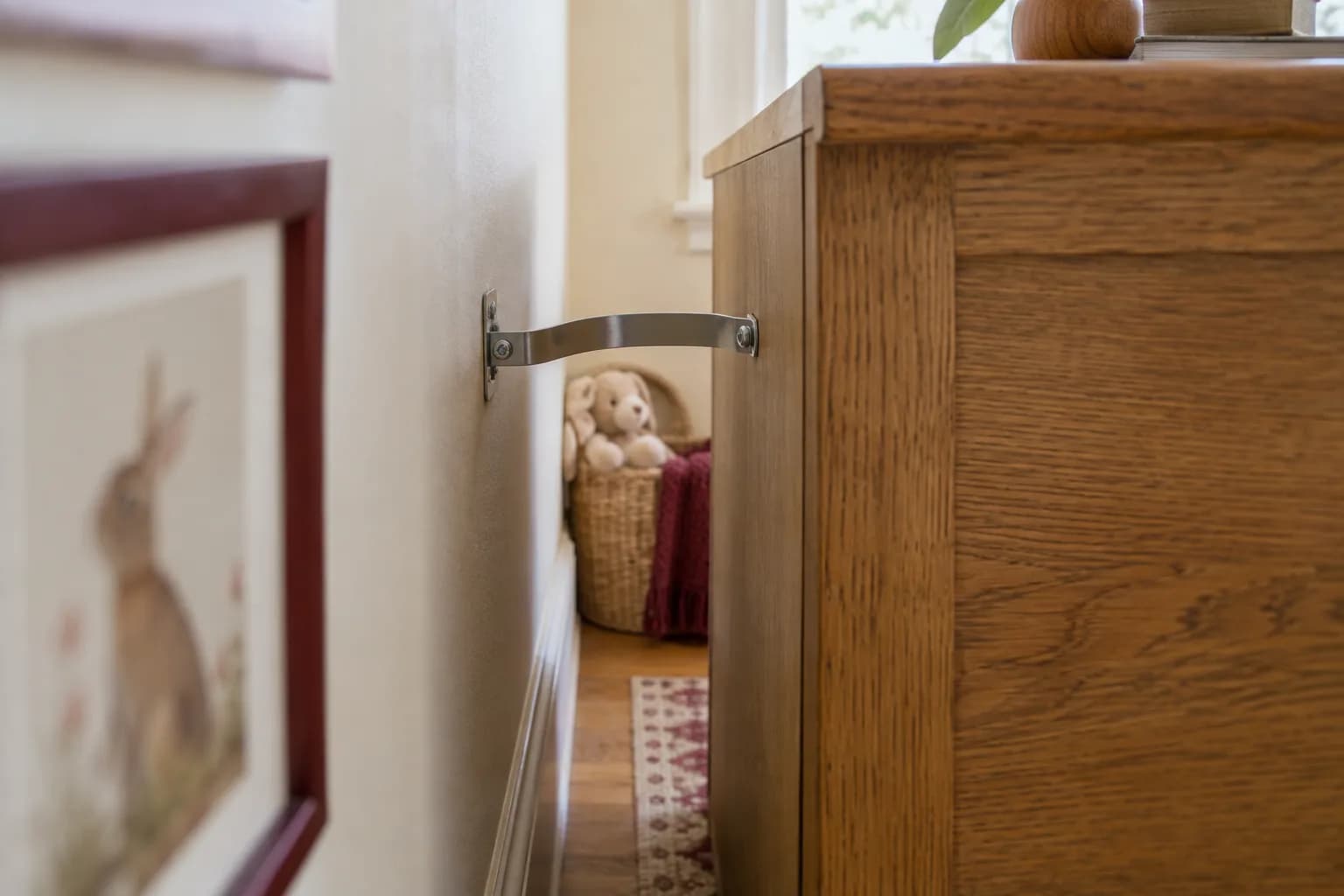
Anchor It! lays out the basic sequence: attach a bracket to the wall, move the furniture close to the wall, attach the other bracket to the furniture or TV, connect the strap between them, and tighten it. Tools on its list include an anchoring kit, a drill with bits, a screwdriver, and a stud finder. A few practical notes on each step:
- Read the kit instructions first. They tell you what the hardware is designed to fasten into and where it should attach on the furniture, often the top back rail or a reinforced point.
- Find solid framing. A stud finder helps. In many Pittsburgh homes with plaster-and-lath walls, stud finders can be harder to read, and plaster can crack if you drill carelessly. Confirm the stud with a small pilot hole in a spot that will be hidden behind the furniture. Our guide to plaster, brick and drywall explains why the wall type changes the job.
- Attach the wall bracket, then the furniture bracket, using the hardware from the kit or hardware its maker specifies for your wall type. Don't improvise with whatever anchors are left over in a drawer.
- Connect and tighten the strap so there's little slack between the furniture and the wall.
- Test it. CPSC's advice is to tug on the straps to be confident everything is secure.
- Secure TVs as well as the furniture under them. Use a TV anchoring kit or wall-mount the TV. When anchoring isn't possible, CPSC advises placing the TV on a sturdy, low base, pushing it back as far as possible, and keeping cords out of reach. Our TV wall mount guide covers mount types.
Two more CPSC tips that cost nothing: keep heavier items on lower shelves, and don't store toys, remotes, or other tempting items on higher shelves where kids may climb to reach them.
Quick checklist
| Item | Anchor it? | Also check |
|---|---|---|
| Dresser or chest, any age | Yes | If made after Sept. 1, 2023, find the included anti-tip device and install it |
| Bookcase or shelving unit | Yes | Heavier items on lower shelves |
| TV on a stand or dresser | Yes, both the furniture and the TV | Or wall-mount the TV |
| Freestanding cabinet or wardrobe | Yes | Nothing tempting stored on top |
If you're moving into a new place
Anchoring is easy to forget in the chaos of moving day, and it's one of the few setup tasks that matters from the first night a child sleeps in the home. Put "anchor tall furniture and TVs" on the same first-weekend list as smoke alarms and changing the locks. If you're setting up several rooms at once, anchoring can be handled in the same visit as furniture assembly, which saves moving everything twice.
Walk the room from a child's point of view
Look at what might invite climbing: a toy on a high shelf, a remote beside the TV, or an open drawer that resembles a step. Relocate tempting items where appropriate, but do not treat that change as a replacement for the specified anchoring. A room can look tidy while still containing unsecured furniture.
Make a list of furniture and TVs by room, including pieces in guest rooms and secondary living areas. Record the model if known, whether the instructions are available, and whether the current anchoring arrangement can be identified. A strap disappearing behind a cabinet is not enough information if you do not know what it connects to or whether it suits that product.
Do not test furniture by deliberately tipping it or letting a child climb to see what happens. Keep children out of the inspection area while furniture is moved or attachment points are assessed. If a piece is unstable, damaged, or not secured as required, limit access until the appropriate correction is made.
Inherited furniture needs its own assessment
Secondhand furniture may arrive without hardware, labels, or instructions. Start by identifying the manufacturer and model where possible. Photograph the rear construction and existing attachment points before ordering a generic kit. A suitable anti-tip system needs a compatible connection to both the furniture and the wall; a thin back panel should not be assumed to provide the required furniture attachment.
Do not assume an old strap or fastener is suitable simply because it was attached at the previous home. The new wall may differ, parts may be missing, and the furniture may have been damaged in transit. Find the manufacturer's guidance or obtain a competent assessment of an appropriate method. If a safe securing method cannot be established, reconsider where and whether the piece should be used.
The same applies when a TV is placed on a stand. Treat the television and the supporting furniture as separate items to assess. A secured TV does not automatically secure the cabinet, and an anchored cabinet does not by itself establish that the television is protected against tip-over.
Keep anchoring information with the furniture
Record the kit or system used, retain the instructions, and photograph the completed arrangement where it can be documented safely. The purpose is not to certify the installation yourself; it is to make later inspection and relocation easier. Note any manufacturer guidance about inspection and replacement.
Revisit the arrangement after moving the piece, changing its location, or changing the wall finish in a way that disturbed the attachment. Do not reconnect parts from memory without checking their intended use. A new TV, heavier contents, or a different furniture configuration also warrants a fresh assessment.
At a service walkthrough, ask to see which items were addressed and which remain outstanding. If a compatible part must be obtained, write that down clearly and keep the area protected in the meantime. Supervision, careful loading, and ordinary household rules are useful habits, but they do not replace the anchoring measures recommended for the product.
FAQ
I rent. Can I drill into the walls to anchor furniture? That depends on your lease, so ask your landlord before drilling. Anchoring leaves small screw holes, so it's worth getting a yes in writing before you start.
My new dresser came with an anti-tip device. Is it already doing its job? Only if it's installed. Covered dressers must come packaged with the device, but it does nothing coiled up in the box or the back of a drawer.
What if there's no stud where the furniture needs to go? Check the anchoring kit's instructions for what it allows. If the kit calls for framing and there's none in the right spot, don't substitute a light-duty anchor. Ask the manufacturer, or have someone assess the wall.
Does a wall-mounted TV still need an anti-tip strap? A TV on a properly installed wall mount (rated for the TV's size and weight, fastened per the mount maker's instructions) isn't sitting on furniture that can tip, so the mount does that job. Any furniture under it still needs its own anchoring.
Get it done this weekend
If a whole house of furniture feels like more than an afternoon, especially in an older home where finding solid anchor points takes judgment, request an estimate. Send a few photos of the pieces and the walls behind them, and you'll see the full price or the full hourly rate before we start, with no fees added after the job.