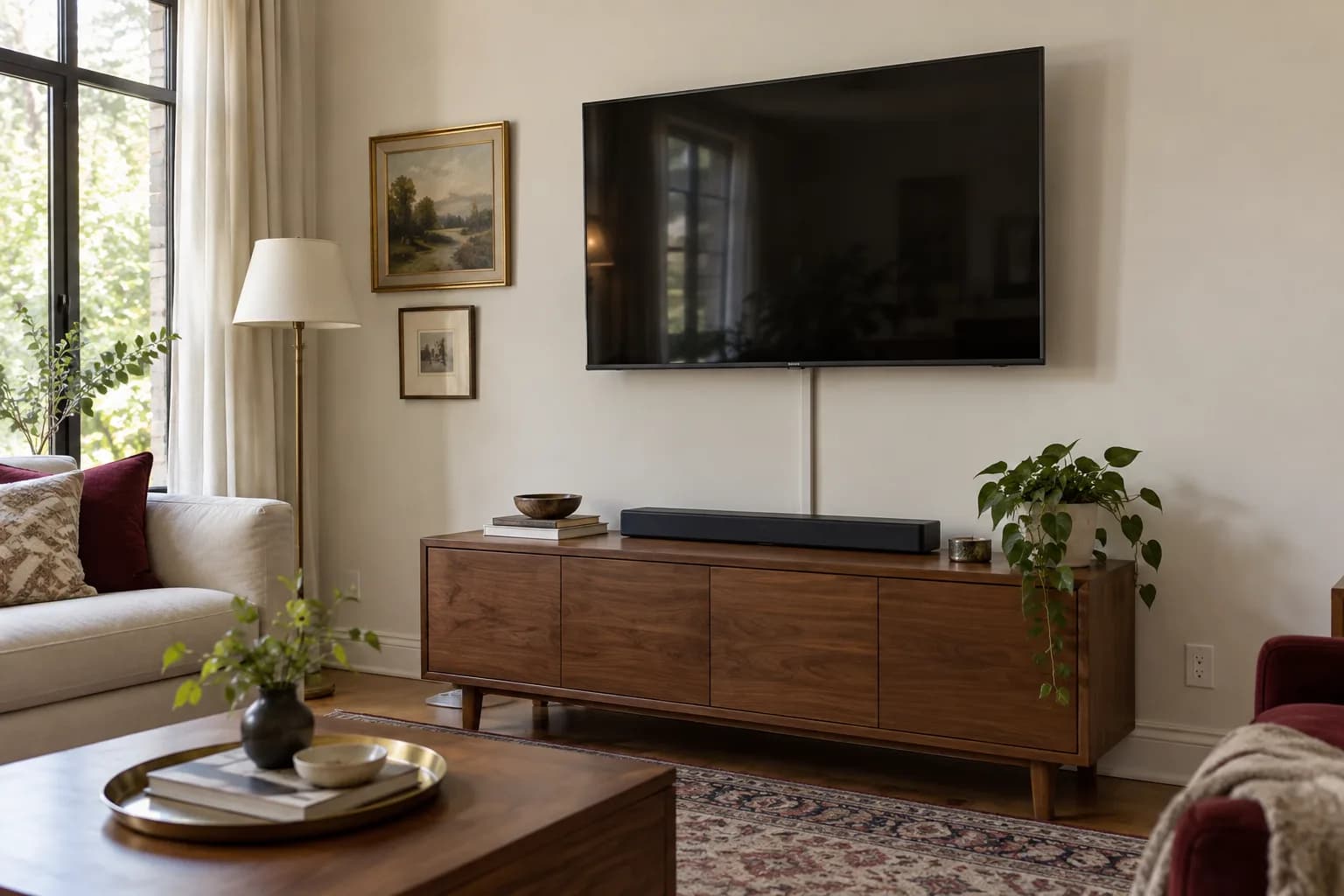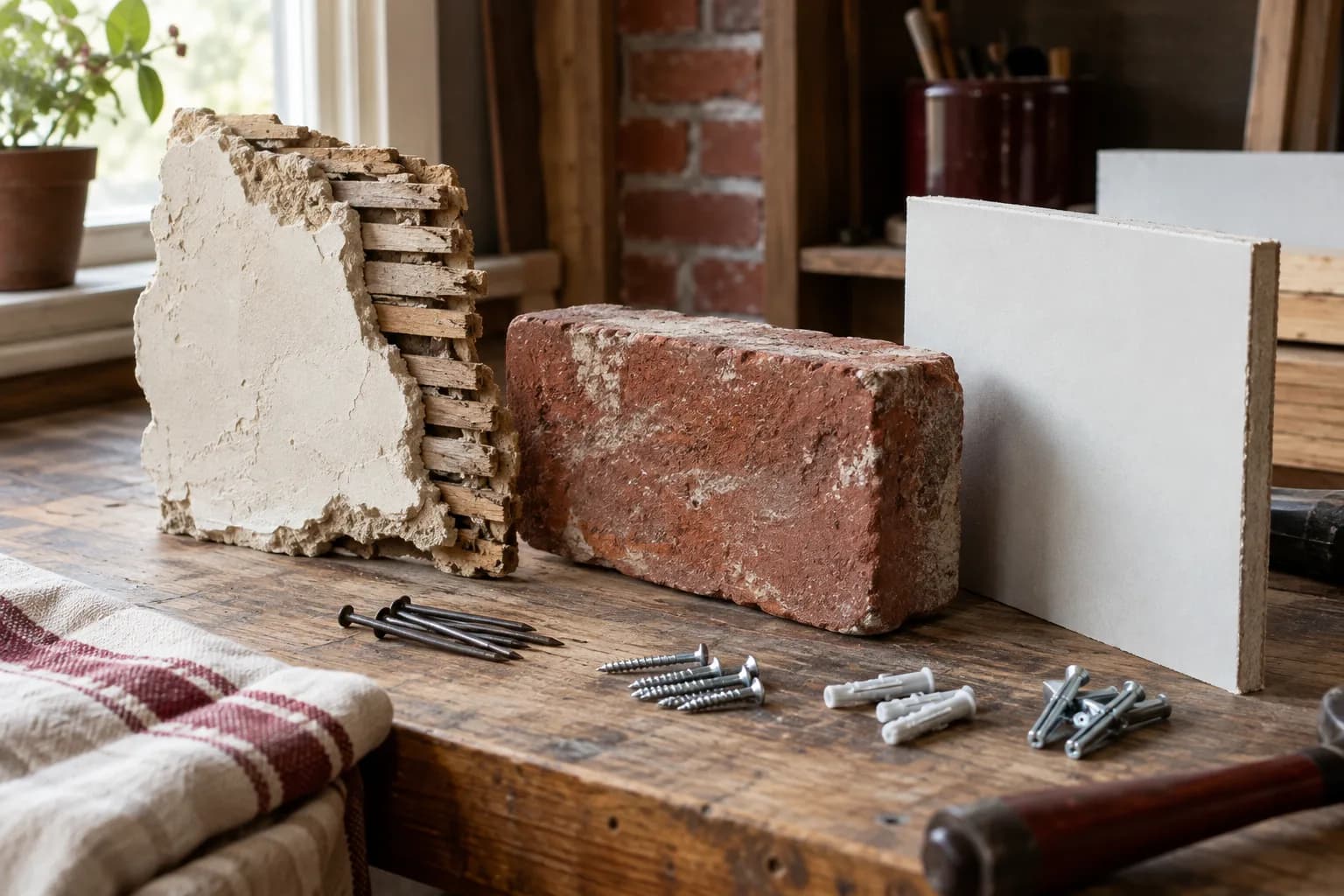
Before anyone quotes a TV mount, a shelf, or a heavy mirror, the first useful question is: what is the wall made of? Drywall, plaster, and brick can all hold a mount. They just need different tools, different fasteners, and a different pace, and in older homes you can find more than one on the same floor.
Quick answer
- Drywall is easy to drill but weak on its own. Heavy items should go into the studs behind it.
- Plaster is harder and less forgiving. It can crack or break away around a hole if it's drilled carelessly, and studs can be harder to locate.
- Brick and masonry have no studs. The wall itself carries the load, so the job needs masonry bits, a hammer drill, and anchors made for that material.
- Knowing which one you have up front means a more accurate quote and fewer surprises on the day.
How to tell what's behind the wall
A few low-risk checks you can do yourself:
- Knock on it. Drywall between studs tends to sound hollow. Plaster usually sounds duller and more solid. Brick sounds and feels like stone.
- Think about the age of the house. The National Park Service notes that plaster was the wall surface chosen for nearly all buildings until the 1930s or 40s. Many older Pittsburgh homes and rowhouses fall into that range, although walls may have been replaced with drywall during later renovations.
- Look at an edge. With the power to that circuit off, remove a switch or outlet cover plate and look at the cut edge of the wall around the box. Drywall shows a paper face over a chalky gypsum core. Plaster shows a harder, layered material, sometimes with wood strips or metal mesh behind it.
- Check the outside. If the exterior of the house is solid brick, the inside face of an exterior wall may be plaster applied over furring strips or directly on the masonry, so a stud finder may not behave the way you expect.
Drywall: thin, forgiving, but needs the stud for weight
Drywall is a sheet of gypsum with a paper face, screwed or nailed to wood or metal studs. It drills cleanly and patches easily, but the board itself is not what should carry a heavy load.
- TVs and heavy shelves: fasten into studs. A stud finder, a small magnet to find screws, or a thin test nail in a spot the TV will hide all help confirm the stud before the mount goes up.
- Light items: hollow-wall anchors can work for lighter pieces when the anchor is rated for the item's weight and the wall thickness. Check the rating on the package rather than guessing.
- Mount instructions come first. TV mount manufacturers specify which walls and fasteners their mounts are designed for, and those instructions are the rule to follow.
Plaster: harder, older, and unforgiving of guesswork
Traditional plaster isn't a single sheet. According to the National Park Service's guidance on historic plaster, it was applied in three coats over wood lath or metal lath (a scratch coat, a brown coat, and a finish coat), while gypsum-board "rock lath," in use as early as 1900, allowed a two-coat job. Wood lath is a row of thin wooden strips with gaps; the wet plaster pushed through those gaps and hardened into "keys" that hold the wall on.
That construction explains how plaster behaves during a mounting job:
- It can crack or break away around a hole. Drilling too fast, using a worn bit, or driving a screw without a pilot hole can chip the surface or loosen plaster from the lath. Slow, steady drilling with the right bit and a pilot hole goes a long way.
- Studs are harder to find. Thick, dense plaster and metal lath can confuse a basic stud finder. A careful approach may include a small test hole in a spot the TV or shelf will cover.
- Repairs take more care. A misplaced hole in drywall is a quick patch. In plaster, a patch needs to bond to the old material and blend with the surface.
A note on older painted walls
Older plaster walls often come with older paint. The EPA says approximately three-quarters of U.S. homes built before 1978 still contain some lead-based paint, and that any renovation, repair or painting project in a pre-1978 home that has lead-based paint can easily create dangerous lead dust. Drilling a few mounting holes is a much smaller job than sanding or scraping a whole wall, but it's one reason we keep dust contained and clean up carefully in older homes. If you're planning a bigger project that disturbs painted surfaces in a pre-1978 home, read the EPA's Renovation, Repair and Painting program page before the work starts.
Brick and masonry: strong, but a different toolkit entirely
Solid brick, block, or stone walls don't have studs; the wall itself is the structure. Mounting into masonry usually means:
- A hammer drill or rotary hammer and masonry bits instead of a standard drill and wood bits.
- Masonry anchors chosen for the specific base material. Anchor manufacturers state which materials each anchor is rated for, and solid brick, hollow block, and old soft brick don't all behave the same way.
- Careful placement. A hole in brick can't be nudged an inch to the side the way a screw in drywall can, so measuring and marking takes longer.
- Dust control. Masonry drilling produces fine dust, so the area gets covered and vacuumed as the work goes.
Also check whether you're looking at solid masonry or a finish over framing. Some walls that look like brick are a brick veneer or a thin brick facing over a framed wall, which changes where the load should go.
Why this changes the estimate
The wall type changes the time more than anything else:
| Wall type | What usually takes longer |
|---|---|
| Drywall over wood studs | Usually the most straightforward |
| Plaster over lath | Locating studs, slower drilling, careful patching |
| Brick or block | Masonry drilling, anchor selection, dust control |
| Mixed or unknown | Investigation before the first real hole |
That's why photos help so much. A clear shot of the wall, the area around an outlet, and the item you want hung lets us plan the right tools and hardware before we arrive.
Choose the location and the fastening system together
Start with the item's complete installation requirements: weight, mounting pattern, bracket geometry, and intended movement. A television close to the wall and one on a long articulating arm do not load the fasteners in the same way. A wall's visible surface is only one part of the decision; the backing, condition, and approved anchor application matter too.
Send the installer a wide photograph of the wall and a close photograph of the intended position. Include the adjacent doorway, outlets, trim, and any visible repair patches. Add the exact mount and television model, or the manufacturer's instructions for a shelf. A picture cannot confirm hidden construction, but it can expose questions that should be answered before arriving with a single assumed solution.
If the proposed location does not provide suitable support, consider another position, a different bracket, or a separate qualified assessment. An inconvenient stud location is not a reason to improvise a fastening method outside its specifications. Likewise, a wall that looks like brick may be a veneer over a different structure.
Keep hidden services and old finishes in the plan
A stud finder is a useful tool, not proof that a drilling path is free of wires or pipes. Existing outlets, switches, plumbing fixtures on the other side, and previous alterations help identify where further investigation is needed. Do not infer a safe hole depth from appearance alone. If hidden services are uncertain, pause the mounting decision instead of solving the uncertainty with a larger drill bit.
Older plaster can be detached from its backing, and masonry can have weak or deteriorated joints. Fasteners need sound material, not simply a strong-sounding wall category. Existing cracks, loose sections, moisture staining, or a history of patching deserve inspection before a mount covers them.
For older painted surfaces, assess the possibility of hazardous coatings before drilling or creating dust. The EPA's renovation guidance is linked in the sources for this article. Ask the contractor to confirm the applicable precautions and qualifications; a general mounting appointment should not silently become hazardous-material disturbance.
What to check after the mount is installed
Review the intended operating range with the installer. A movable arm should travel without pinching cables, contacting the wall unexpectedly, or pulling against a connector. A shelf should be level and loaded only within the documented limits of the whole assembly, not an isolated fastener's packaging claim.
Keep the mount instructions and a record of the installed hardware. If you later change the television, shelf contents, or arm position, compare the new use with those specifications. More substantial equipment can require a new assessment even when the mounting holes are already present. Our TV size and height guide can help settle the room layout before that assessment.
FAQ
Can you mount a TV on plaster without hitting a stud? For a TV, we plan to fasten into studs behind the plaster, or into solid masonry on a masonry wall, following the mount manufacturer's instructions. Anchors in plaster alone are for lighter items, within the anchor's stated rating.
Is mounting into brick more expensive than drywall? It usually takes longer because masonry drilling is slower and needs different anchors, so an hourly or flat quote tends to reflect that time.
How can I tell if my house has plaster or drywall? Knock on the wall, consider when the house was built, and look at the cut edge around an outlet or switch box with the power off. Those checks take a few minutes.
Will drilling crack my plaster? It can if it's rushed. A sharp bit, a pilot hole, and steady pressure make cracking much less likely, which is why plaster jobs take a bit longer.
Get an accurate quote for your wall
Mounting feasibility depends on the wall's condition, structure, and the item's requirements; identifying the construction keeps the assessment and scope realistic. Request an estimate with a few photos of the wall and the item, and we'll tell you what the job involves before we start. You can see everything we handle on our TV mounting services page.