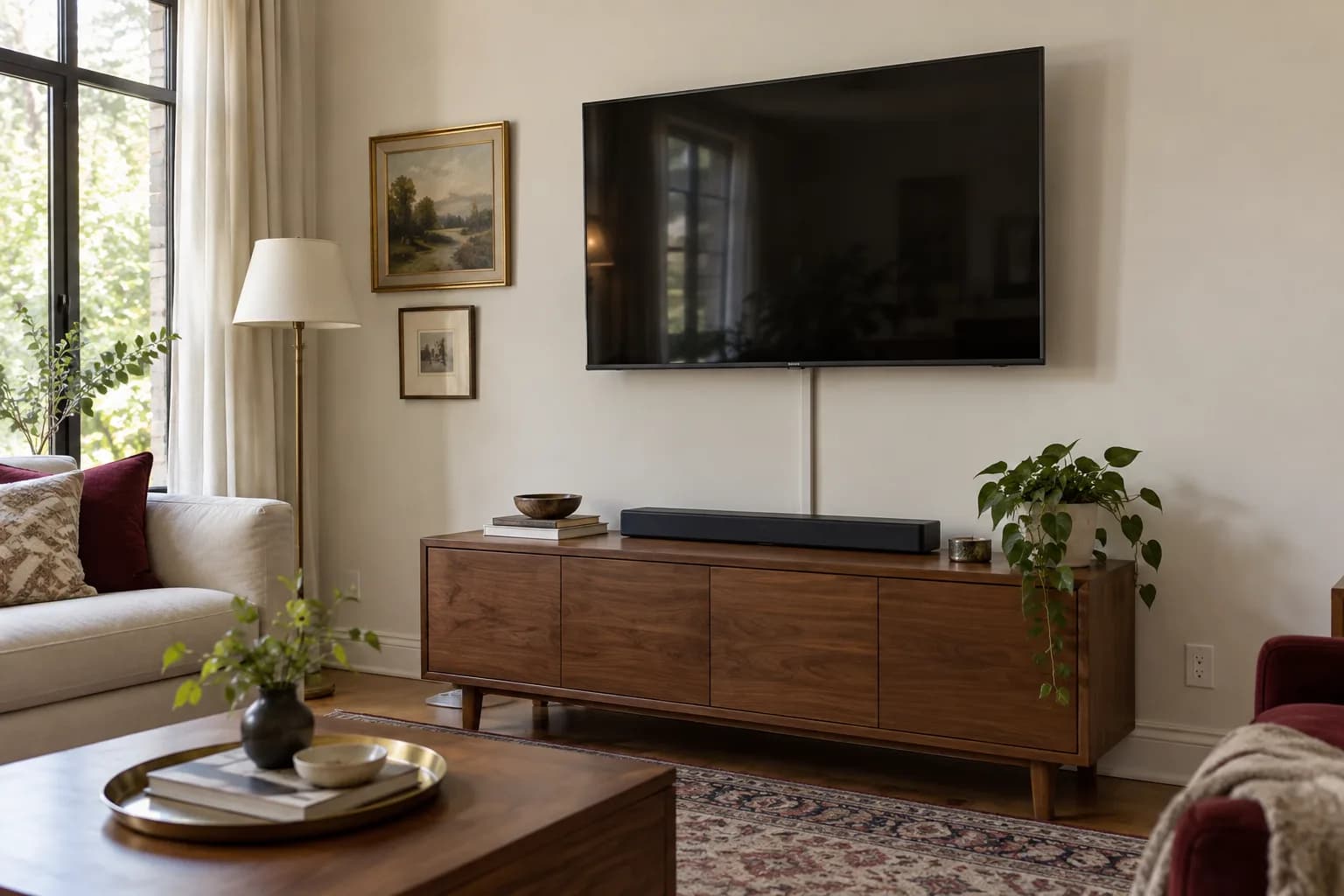
A wall-mounted TV looks finished only when the cables stop dangling below it. The good news: there are three practical ways to get there, from a quick stick-on cover to a fully hidden setup. The catch: the TV's power cord needs a different solution than the HDMI cable, and that's where most shortcuts go wrong.
Quick answer
- Cord cover (surface raceway): a simple option without wall-cavity cutting; removal can still affect the finish. You still see a slim, paintable channel.
- In-wall low-voltage kit: hides HDMI, coax, and speaker wire behind the wall between two flush plates. It does not hide the power cord.
- In-wall power kit or new outlet: the only way to hide the power cord too, because it puts proper wiring (not the cord) inside the wall.
Why "just push it through a hole" is the wrong move
The obvious shortcut is to drill a hole behind the TV and another near the floor, then feed the power cord or an extension cord through the wall. Don't.
OSHA's electrical rules for workplaces (29 CFR 1910.305) say flexible cords and cables may not be used "as a substitute for the fixed wiring of a structure," "where run through holes in walls, ceilings, or floors," or "where concealed behind building walls, ceilings, or floors." The National Electrical Code (NFPA 70) has a similar "uses not permitted" section for flexible cords (section 400.12 in the 2023 edition).
The practical reason is easy to picture. A cord jacket isn't designed to rub against a stud edge or a rough drywall cutout for years, and if it gets damaged inside a wall, nobody sees it. So the power side needs either to stay outside the wall, or to be replaced inside the wall by wiring meant to live there.
The three real options
1. Surface-mounted cord covers
A cord cover is a plastic channel that sticks or screws to the wall and snaps closed over the cables. It's the right choice more often than people expect:
- No cutting into the wall cavity, so no surprises with hidden pipes or wiring.
- Potentially easier to remove than a concealed route, subject to attachment method, finish, and landlord permission.
- Most can be painted to match the wall, so the channel reads as a faint line instead of a tangle.
- Legrand's CordMate product information describes a particular channel's intended use. Use a raceway explicitly suitable for the intended cords and cables, and follow its capacity and separation instructions. Surface placement alone does not make every channel suitable for every combination.
A few tips for a clean result: measure the bundle before buying so the cover closes without pinching, run it straight down (or straight across to a corner) rather than at an angle, and leave a little slack at each end so the TV can be pulled away from the wall for service.
2. In-wall low-voltage kits
This kit uses two flush wall plates, one hidden behind the TV and one lower on the wall near your outlet or media shelf, with the cables fished through the cavity between them. It hides HDMI, coax, network, and speaker wire nicely. The power cord still has to reach an outlet some other way.
The detail most people miss is the cable itself. Cables are listed and marked for where they're allowed to be installed, and the marking is printed on the jacket. For low-voltage audio/video runs inside a wall, you'll typically see power-limited cable types such as CL2 or CL3. UL, which tests and lists these products, explains that cable types are evaluated for fire behavior according to their intended location, and a suffix on the type tells you more: "P" for plenum, "R" for riser, and no suffix for general purpose.
Many ordinary HDMI and speaker cables sold for use behind a TV stand carry no in-wall marking at all. Before a cable goes into the wall, check the jacket for the marking rather than assuming.
3. In-wall power (the full disappearing act)
To hide the power cord, there are two common paths:
- A new outlet behind the TV, added by a licensed electrician using proper fixed wiring from an existing circuit. The TV's short cord then plugs in right behind the screen.
- A purpose-built in-wall power kit, which uses a recessed outlet behind the TV connected through the wall to an inlet lower down. These kits are designed so the TV's own cord never enters the wall, and they need to be installed exactly as the manufacturer's instructions describe.
A suitable power arrangement can be paired with an approved signal-cable route to conceal the connections, subject to the wall and equipment layout. If you're unsure whether your project needs an electrician or a permit, ask before any wall gets cut. Local rules and inspection practices vary, and we'll tell you plainly if a job belongs to an electrician.
Quick comparison
| Option | Hides power cord? | Hides HDMI/cable? | Wall work | Reversible |
|---|---|---|---|---|
| Cord cover | If the selected product permits it | If the selected product permits it | Surface attachment | Removal may affect finish |
| In-wall low-voltage kit | No | Yes | Two openings | Openings can be patched |
| In-wall power + low-voltage | Yes | Yes | Openings plus power work | Mostly permanent |
What happens during an in-wall visit
For an in-wall job, the sequence usually looks like this:
- Confirm exactly what goes in the wall: audio/video cables only, or power too.
- Locate studs and check the path for obstructions such as horizontal blocking, insulation, pipes, or existing wiring.
- Mark both openings so they sit inside the same stud bay and will be hidden by the TV and furniture.
- Cut the openings, fish the cables, and install the plates.
- Test every connection with the TV running before the job is called done.
Older Pittsburgh homes add their own wrinkles. Plaster over lath is harder to cut cleanly than drywall, and blocking inside a wall can interrupt a straight run. If the TV wall is solid brick, as some rowhouse walls are, there may be no hollow cavity to fish through at all, and a cord cover is often the realistic answer.
Renting vs. owning
Renters may prefer a surface cord cover after checking permission and finish compatibility. Adhesives can lift paint, and screw-mounted covers leave attachment holes; plan removal as well as installation. If you're considering anything in-wall, check your lease first. Homeowners who expect the TV to stay put for years get the most out of an in-wall setup, especially if the room is being painted or renovated at the same time.
Make a connection map before hiding anything
List each device, its power location, and the signal connection it needs. Include equipment you use occasionally, such as a game console or a laptop. Then sketch where the TV, cabinet, soundbar, and sources will sit. A diagram does not need to be polished; it needs to show which cables travel together and which connection points must remain accessible.
Check the cable length through the mount's intended movement. The route when the TV is flat may be shorter than the route when it is pulled forward or turned. Allow the connection to move as the equipment instructions permit without making an unsupported hanging loop or trapping it in the mount. Do not substitute a cable's flexibility for checking the correct bend and routing guidance.
Think about future replacement too. A concealed route that works for today's slim cable may not accept a different connector later. Ask how a failed cable could be removed, whether access points remain reachable, and which parts of the system are permanent. A clean appearance should not make an ordinary equipment change unnecessarily destructive.
Choose the least invasive route that meets the goal
For a hypothetical rental living room, a thoughtfully placed surface raceway might satisfy the goal of hiding a distracting cable bundle while preserving a more reversible installation. Confirm permission, adhesive compatibility, and finish expectations; “removable” does not guarantee that every painted surface will be unaffected.
For a long-term installation, concealed signal routing may be worth assessing, but the wall conditions can change the plan. Existing obstructions, insulation, uncertain services, or a wall assembly that should not be opened casually may limit the route. A photo-based estimate should identify these unknowns instead of presenting concealment as guaranteed.
Keep line-voltage electrical work separate from ordinary cable organization. Whether a particular power solution is acceptable depends on the exact product, installation, and applicable requirements. Obtain the appropriate qualified assessment rather than treating an in-wall kit as a blanket exemption. Taskburgh's cable-management scope does not imply electrical contracting.
Test the whole system before the finish closes
Before decorative covers or final trim make access harder, verify the functions you actually use. Check the correct input on the TV, picture and sound from each source, remote operation, and any network-dependent functions that are part of the setup. A cable can be connected physically while the selected port or device setting prevents the intended result.
Move the screen through its agreed range and watch the cables. They should not pull a plug, catch on an edge, or interfere with the mount. Label the source ends where useful, and photograph the route before it disappears behind furniture or a cover. That small record can simplify later troubleshooting.
At handoff, identify what the installation includes: surface organization, signal routing, mounting, and any separately arranged electrical work. Keep relevant product instructions and note how to access the system. You should know which cover can be opened for a cable change and which work requires a fresh assessment rather than improvisation.
FAQ
Can I DIY an in-wall HDMI kit? Many people do. Check that the cable is marked for in-wall use, confirm the stud bay is clear before cutting, and keep the power cord out of the wall. If adding an outlet is part of the plan, that's electrician work.
Can I run the TV's power cord inside a cord cover? Yes. A cover keeps the cord on the wall surface rather than inside the cavity. Choose a cover large enough that the cord isn't crushed or kinked when it snaps closed.
What if I move the TV later? A cord cover comes off. A low-voltage kit leaves two openings that can be covered with blank plates or patched and painted. A new outlet generally stays in place.
Does the cable type matter if the run is short? Yes. The in-wall marking is about where the cable is installed, not how long it is.
Get it done right
Not sure which option fits your wall, your TV, and your lease? Send a couple of photos of the wall and the TV, and we'll recommend one of the three and tell you whether any part of it needs an electrician. You'll see the full price or the full hourly rate before we start. Request an estimate, or browse everything on our TV mounting services page.