Quick answer
"Wood furniture" is a category, not a single material. Solid wood is sawn lumber. Plywood is thin sheets of wood veneer glued together with the grain of neighboring layers running in different directions. MDF (medium-density fiberboard) is wood broken down into fibers and pressed into a smooth, uniform panel. Particleboard is wood particles bonded with adhesive, usually with finer particles on the surfaces and coarser ones in the core. Each has legitimate uses. The mistake is not knowing which one you're buying — or paying solid-wood prices for particleboard construction.
How each material is actually made
Solid wood
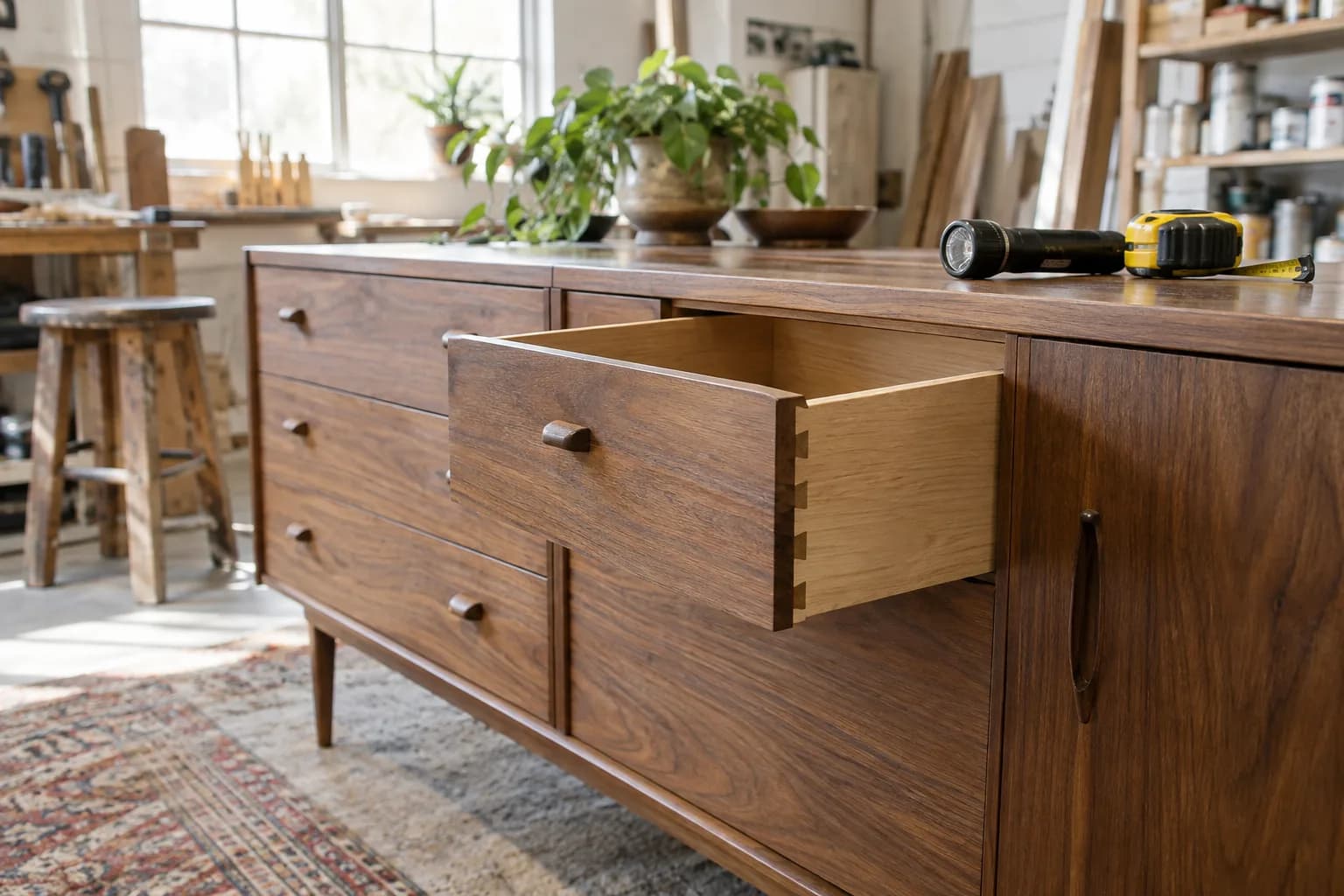
Solid wood furniture is built from boards of natural lumber, often several boards glued edge to edge to make a wider top or panel. Pieces are joined with woodworking joints (mortise-and-tenon, dovetails, dowels) or with screws and bolts. Because it's a natural material, its appearance and strength vary from board to board, and it moves — expanding and shrinking slightly — as indoor humidity changes through the seasons. That's why a well-made solid-wood tabletop is attached in a way that lets it move rather than being locked down rigidly.
Plywood
Plywood is a panel built up from sheets of veneer called plies. According to the USDA Forest Products Laboratory's Wood Handbook, plywood is always constructed with an odd number of layers, with the grain of adjacent layers oriented perpendicular to one another. That cross-lamination is the point: compared with solid wood, the differences in strength and stiffness along the panel versus across it are much smaller, dimensional stability is excellent in both directions, and the alternating grain significantly reduces splitting when screws or nails go in near an edge.
One detail worth knowing: the Handbook notes that the center layer of plywood may be veneer, lumber, particleboard, or fiberboard. So "plywood" on a furniture listing doesn't always mean veneer all the way through.
MDF (medium-density fiberboard)
MDF is a type of fiberboard. Instead of cutting wood into sheets or chips, manufacturers break it down into individual fibers — for MDF, typically in steam-pressurized refiners — then coat the fibers with resin, form them into a mat, and press it into a panel. The Handbook explains that because fiberboard exploits the fibrous nature of wood, it uses wood's inherent strength to a greater extent than particleboard does, and that MDF is frequently used in place of solid wood, plywood, and particleboard in furniture.
Because it's made from fine fiber, MDF has no visible grain or knots and a very smooth, consistent surface. That's why it shows up so often in painted furniture, cabinet doors, and flat panels where a clean surface matters.
Particleboard
Particleboard is made by breaking wood into particles, coating them with adhesive, and pressing them into a panel. The Handbook says it is typically made in three layers, with fine particles on the faces and coarser material in the core, which produces a smoother surface for laminating, overlaying, painting, or veneering. It also says plainly that particleboard is "generally not as strong as fiberboard," that it is widely used in furniture where it is overlaid with decorative materials, and that it is the predominant material used in ready-to-assemble furniture.
That last point matters when you shop: a flat-pack dresser with a wood-look finish is very often particleboard underneath a thin laminate or foil.
Side-by-side comparison
| Material | Made from | Strength in practice | Around moisture | Common furniture use |
|---|---|---|---|---|
| Solid wood | Sawn lumber boards | Strong and repairable, but varies with grain | Moves with humidity; needs a sealed finish | Frames, legs, tabletops, long-life pieces |
| Plywood | Cross-laminated veneer layers | Strong in both directions; holds fasteners near edges well | Stable; minimal permanent swelling if wetted | Cabinet boxes, drawer bottoms, shelving, backs |
| MDF | Refined wood fiber and resin | Stronger than particleboard; uniform | Can swell if it gets wet, especially at edges | Painted furniture, doors, flat panels |
| Particleboard | Bonded wood particles | Less strong than fiberboard; least tolerant of re-driven screws | Can swell permanently if it gets wet | Flat-pack furniture, cabinet and shelf cores |
Does the material matter for indoor air, too?
If you've heard concerns about formaldehyde in furniture, they usually relate to the adhesives used in composite panels. The U.S. EPA regulates formaldehyde emissions from hardwood plywood, medium-density fiberboard, and particleboard, as well as household and other finished goods containing them, when they are sold, supplied, offered for sale, manufactured, or imported in the United States. The rule includes a third-party certification program for testing and oversight, and EPA states that composite wood products must be labeled as TSCA Title VI compliant — so that wording is something you may see on a label or packaging.
If you have specific health concerns, EPA's page on these standards (listed in the sources above) is a better starting point than general online advice.
How to tell what you're actually buying
Retail listings don't always spell out the material. A few ways to check:
- Look for the specific word: "solid wood," "plywood," "MDF," or "particleboard." Vague terms like "wood," "wood-look," "engineered wood," or "wood veneer" can describe almost anything, including laminate over particleboard.
- Read the full specifications, not just the headline. Materials are often listed per part — for example, a solid-wood frame with MDF drawer fronts and particleboard sides.
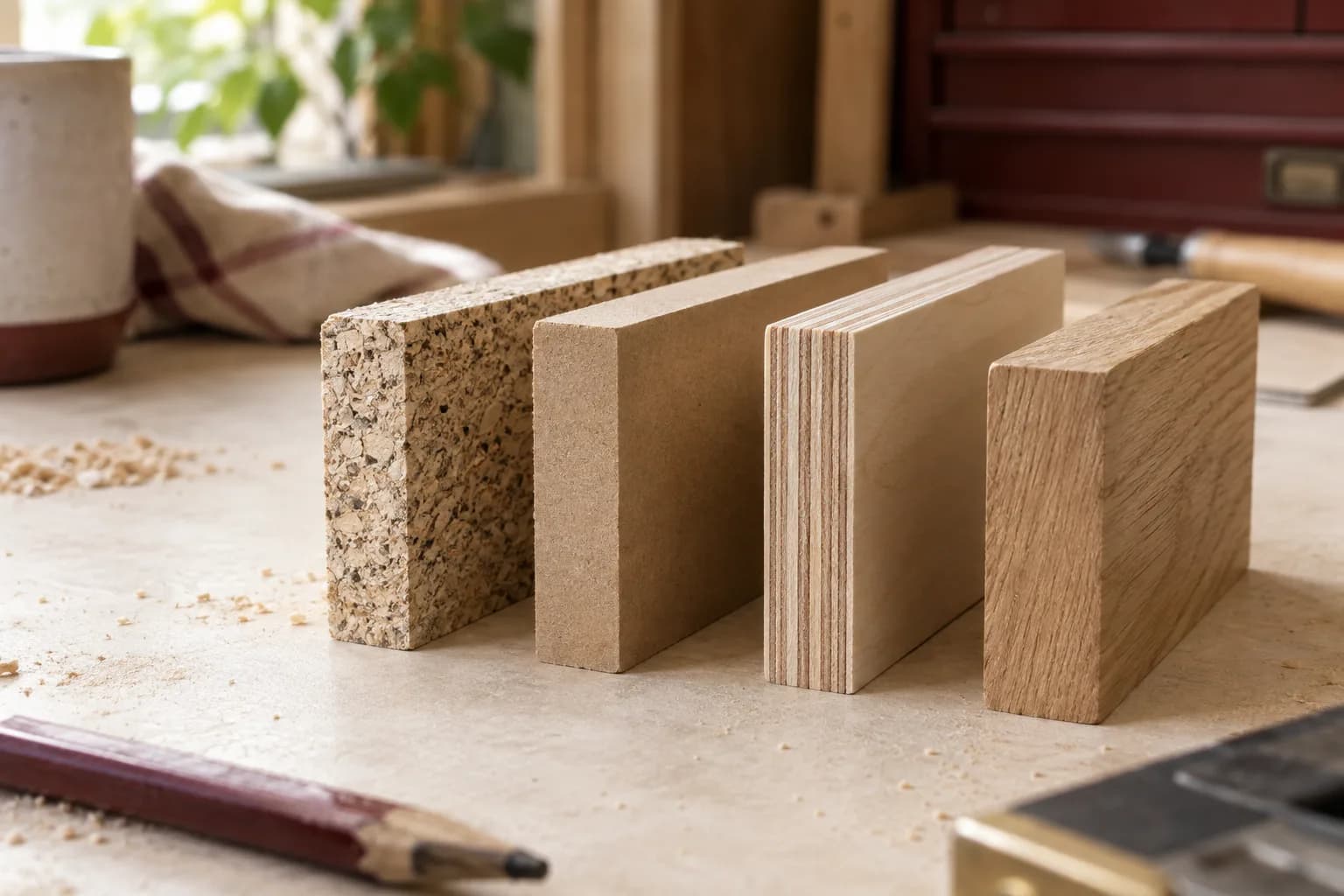
- Look at an exposed edge in person or in close-up photos. Plywood shows visible layers. Particleboard shows a speckled, chip-like core. MDF shows a smooth, dense, uniform edge. Solid wood shows continuous grain that wraps around corners.
- Check inside and underneath. Drawer bottoms, back panels, and the underside of tops often reveal the real material when the outside is covered in veneer or laminate.
- Don't rely on weight alone. Composite panels can be surprisingly dense, so a heavy piece isn't automatically solid wood.
- Ask directly, especially for online purchases. A seller who can't tell you the core material is giving you useful information.
Matching the material to the job
- For pieces that carry weight or get moved — bed frames, bookshelves with long spans, dressers used every day — favor solid wood or plywood in the structure.
- For painted or perfectly flat surfaces, MDF is often a sensible choice, as long as it stays dry.
- For light-use pieces you don't plan to move often, particleboard can be a reasonable, budget-friendly option.
- In kitchens, bathrooms, entryways, and basements — anywhere with spills, damp, or winter slush tracked in — take extra care with particleboard and MDF.
Read construction details beyond the headline material
“Wood furniture” can describe several different structures in one piece. A desk may combine a veneered panel top, solid-wood legs, and a thin manufactured back. A drawer may have solid sides but a lightweight bottom. Ask which parts use which material, especially the parts carrying weight or holding repeated-use hardware.
Edges and joints reveal more than a photograph of the finished face. Look for supported spans, substantial fastening points, protected edges, and hardware that can be serviced. A well-designed manufactured panel can perform better in its intended use than poorly dried or poorly joined solid wood. Material names alone do not rank an entire product.
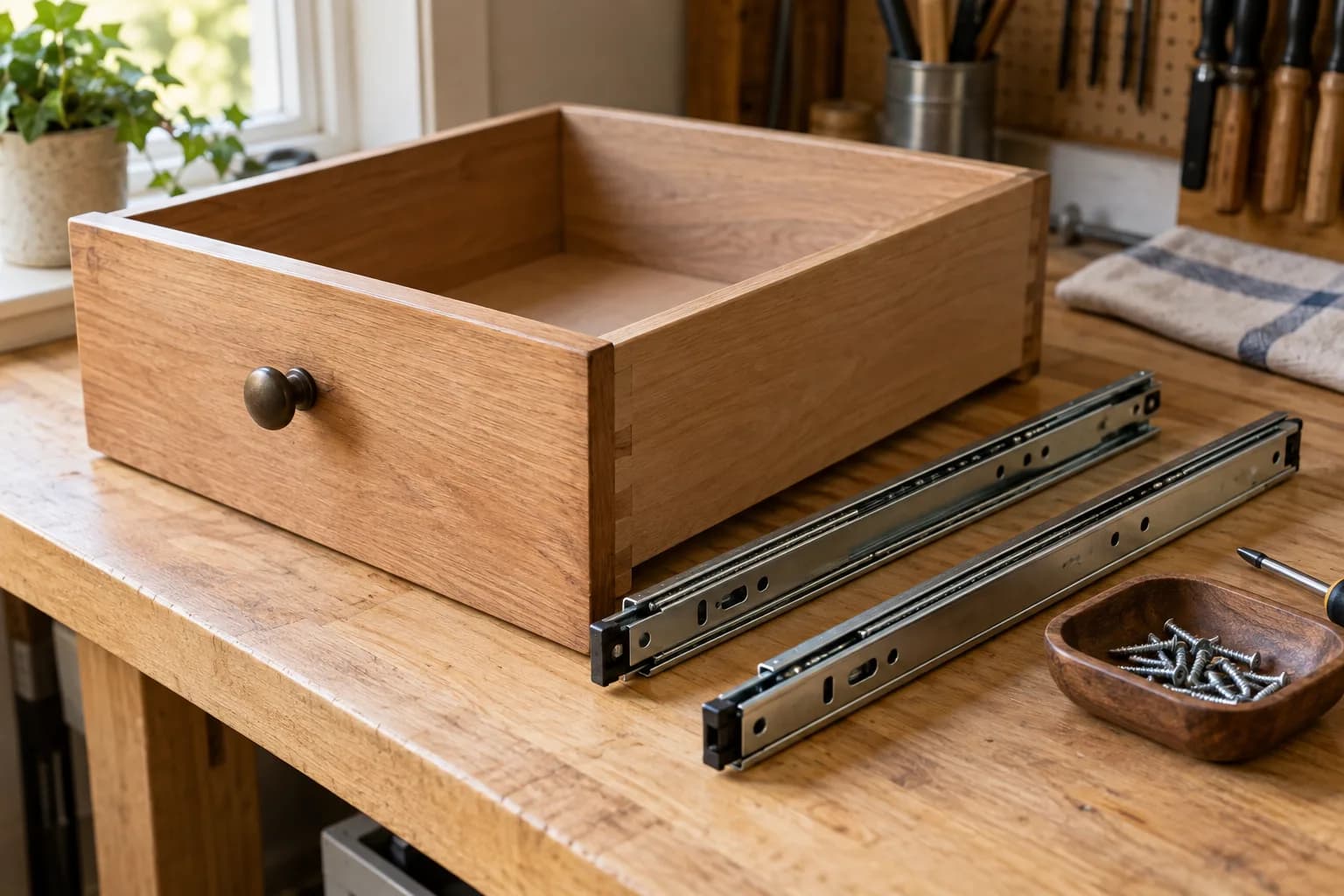
For a bookshelf, consider shelf span and the manufacturer's load rating. For a desk, check where the frame supports the top and whether monitor-arm clamps are permitted. For a dresser, drawer runners and the attachment of the back panel affect daily use. Those are more practical questions than asking whether every visible surface is “real wood.”
Think about the second assembly before the first one
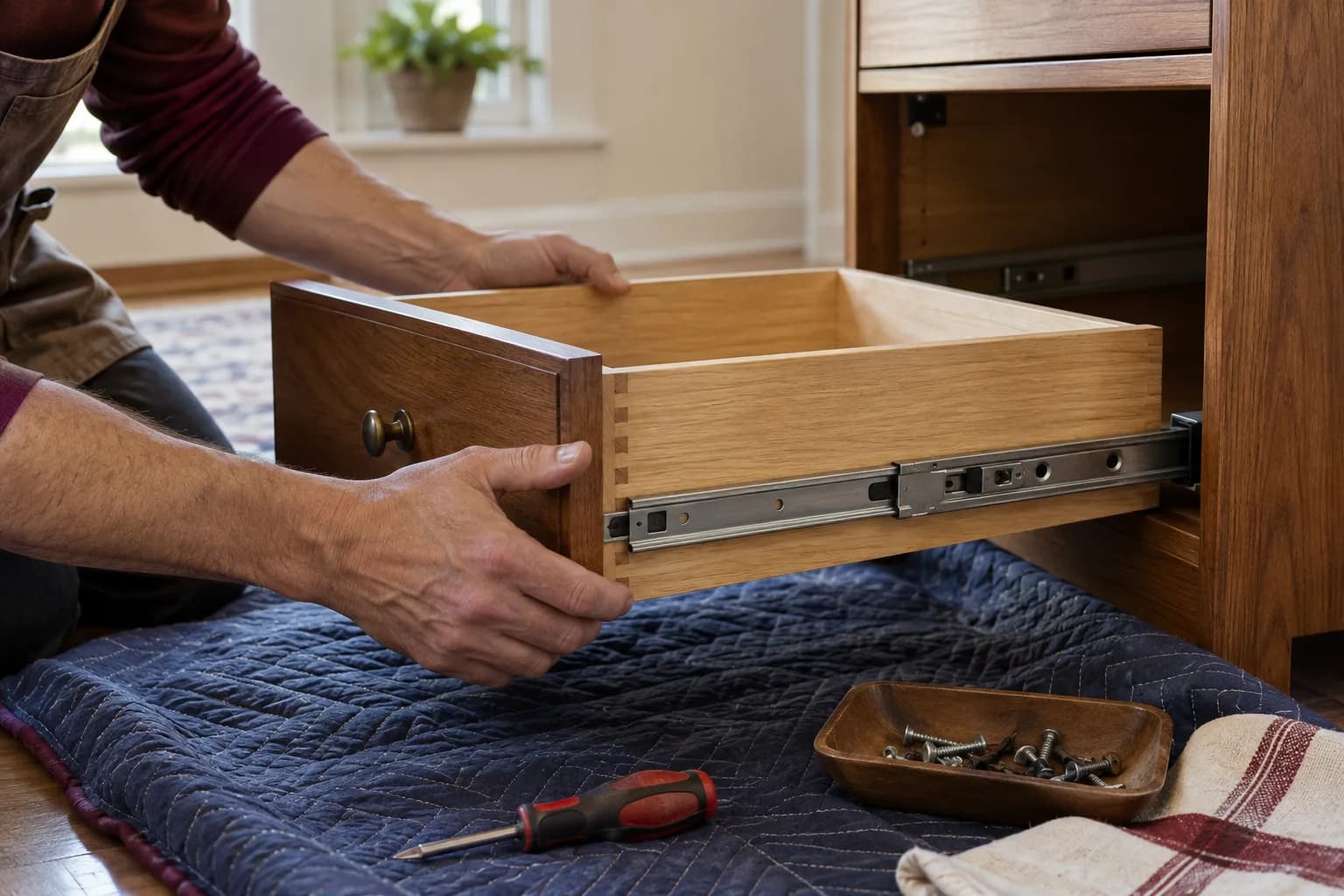
If you expect to move frequently, ask how the piece comes apart and whether the hardware is intended for repeated use. Keep the original instructions and label fasteners by location. Repeatedly driving an unsuitable screw into a worn hole is not a reliable substitute for the intended connector.
A used piece with a stripped fastening hole may need a material-specific repair, replacement panel, or new fitting. The right response depends on the load and the location. A decorative trim joint and a chair leg are not equivalent repair problems. Do not hide swelling or cracked panel edges behind fresh hardware and assume the strength has returned.
Moisture history matters when buying secondhand. Inspect lower edges, the underside of tops, and areas around hardware for swelling, lifting veneer, or softness. Ask whether the item was stored in a damp basement or exposed to a leak. Drying a swollen panel does not necessarily restore its original shape or fastening capacity.
Match care and repair to the actual surface
The finish you touch may be laminate, veneer, paint, oil, or a clear coating. Each can have different cleaning and repair requirements from the material beneath it. Do not sand a veneered surface as though it were a thick solid board, and do not assume a glossy surface tolerates any solvent.
Keep a material note with the product model: top, frame, back, drawers, and finish. That record helps with cleaning, future repairs, and compatible accessories. If a seller cannot identify the construction, factor that uncertainty into the purchase rather than substituting a confident guess. Our repair-or-replace guide provides a way to compare a limited repair with the cost and disruption of replacement.
FAQ
Is plywood better than solid wood? It depends on the job. Plywood is more dimensionally stable and resists splitting better, which is why it's common in cabinet boxes and shelving. Solid wood can be sanded, refinished, and repaired repeatedly, which makes it a good fit for tabletops and pieces you plan to keep a long time.
Is MDF worse than particleboard? Generally no. The Wood Handbook says fiberboard uses wood's strength to a greater extent than particleboard. MDF still isn't a direct substitute for plywood or solid wood where a part carries heavy loads or gets wet.
Can particleboard furniture last a long time? It can, with reasonable care: keep it dry, don't overtighten screws, and don't overload shelves or drawers. It's simply less forgiving of mistakes, spills, and repeated disassembly than plywood or solid wood.
Do I need to worry about formaldehyde in furniture I already own? EPA's formaldehyde emission standards cover composite wood products sold in the U.S., and EPA says labeling as compliant has been required since June 1, 2018, so a piece bought before then may predate the labeling rule. For specific health questions, start with EPA's resources rather than general online advice.
Plan around the material, not against it
Different materials call for different handling — the torque that's fine in solid wood can strip a particleboard hole. If you're not sure what you're working with, request an estimate and tell us what you bought; we'll plan the assembly around it. Browse everything we cover on our furniture services page.