Quick answer
Flat-pack outdoor furniture saves on shipping and storage but usually means more hardware exposed to weather; pre-assembled pieces often cost more but skip the assembly step entirely. For most patio sets, flat-pack is fine if you're comfortable with basic assembly and the piece uses weather-resistant hardware. For gas grills, the calculus changes: assembly involves gas hoses, burners, and ignition components, and a bad connection is a safety problem, not just an inconvenience. The U.S. Consumer Product Safety Commission (CPSC) warns that gas and charcoal grills can present a risk of fire and carbon monoxide poisoning, so where you set the grill up matters as much as how it's built.
What's actually different about outdoor furniture
Indoor furniture just has to hold weight and look good in a room. Outdoor furniture has to do that while sitting through sun, rain, freeze-thaw cycles, and — if you're in a place with real winters — snow load if it's not covered or stored. A few practical differences worth knowing before you buy:
- Metal frames: powder-coated aluminum is light enough to move easily and doesn't rust the way steel does; steel frames depend on their coating, and can start rusting where it chips, including around bolt holes scratched during assembly.
- Resin wicker: is made for outdoor use in a way natural wicker generally isn't, but the weave is only as strong as the frame underneath it — check what the frame itself is made of, not just the visible wicker.
- Cushions and covers: look for covers described as fade- or mildew-resistant and removable for washing, and follow the maker's instructions for drying and storage between uses.
- Hardware: stainless or coated screws and bolts matter more outdoors than indoors, since exposed fasteners are exactly where rust starts on an otherwise solid frame.
Assembled or flat-pack: how to decide
| Factor | Lean pre-assembled | Lean flat-pack |
|---|---|---|
| Getting it up stairs or through a narrow gate | Check delivery access first — assembled furniture is bulkier to carry | Flat boxes usually fit through tighter spaces (rowhouse side yards, narrow gates) |
| Your comfort with basic tools | Less relevant — nothing to build | You'll want at least basic hand-tool comfort |
| Number of pieces and complexity | Worth it for large sectional sets with many identical bolted joints | Fine for a simple bistro set or single chairs |
| Storage before setup | Assembled furniture needs full-size storage until placed | Flat boxes store flat until you're ready |
| Long-term hardware exposure | Nothing to get wrong on your end, but still check that joints are snug | Fine if you follow the manual's tightening and hardware steps carefully |
For most single pieces and small sets, either option works — the deciding factor is usually how the piece gets from the truck to your yard, not the furniture itself. For large sectional sets with dozens of identical bolted connections, paying for assembly (pre-built or a local pro) can save hours and lowers the odds that one rushed joint loosens early.
Grills are a different category
A grill isn't just furniture with a lid — it's a fuel-burning appliance. CPSC's summer grilling safety flyer emphasizes outdoor use with ventilation, away from enclosed spaces and combustible overhead surfaces (CPSC, Summer Grilling Safety). That guidance applies to where you use the grill long after assembly, but it's worth deciding on that spot before you build it, since some grills are heavy enough that relocating a fully assembled unit is its own project.
The same CPSC guidance recommends checking the grill and any gas hoses for cracking, brittleness, holes, and leaks before use — something worth doing once during assembly and again each season, not just out of the box. It also recommends checking cpsc.gov to see whether the grill has been recalled (and to stop using a recalled grill until it's repaired or replaced), never leaving a hot grill unattended, and keeping children away from the grill area.
Beyond placement and inspection, assembly quality on a gas grill affects things you can't easily check later once the cart and side panels are on: whether the burner tubes are seated correctly, whether hose connections are fully threaded and free of kinks, and whether the ignition components are installed as the manual shows. Follow the manufacturer's own leak-check instructions before the first lighting. Much of that is hard to see from outside a finished grill — which is exactly why a careful, methodical assembly matters more here than on a chair or table.
Delivery and space in an older house or a small yard
If you're in a rowhouse or a home with a narrow side yard, tight gate, or a walk-up to a rooftop or second-floor deck, get the delivery dimensions of an assembled piece before you buy — a pre-built sectional sofa or a fully assembled grill cart may simply not fit where a flat box would. Hills and stairs common in older Pittsburgh neighborhoods make this more of an issue than in a house with a flat, wide driveway straight to the patio.
Quick decision checklist
- Measure your access path (gate width, stairs, side-yard clearance) before choosing assembled vs. flat-pack
- For metal frames, check the coating — powder-coated aluminum over uncoated steel
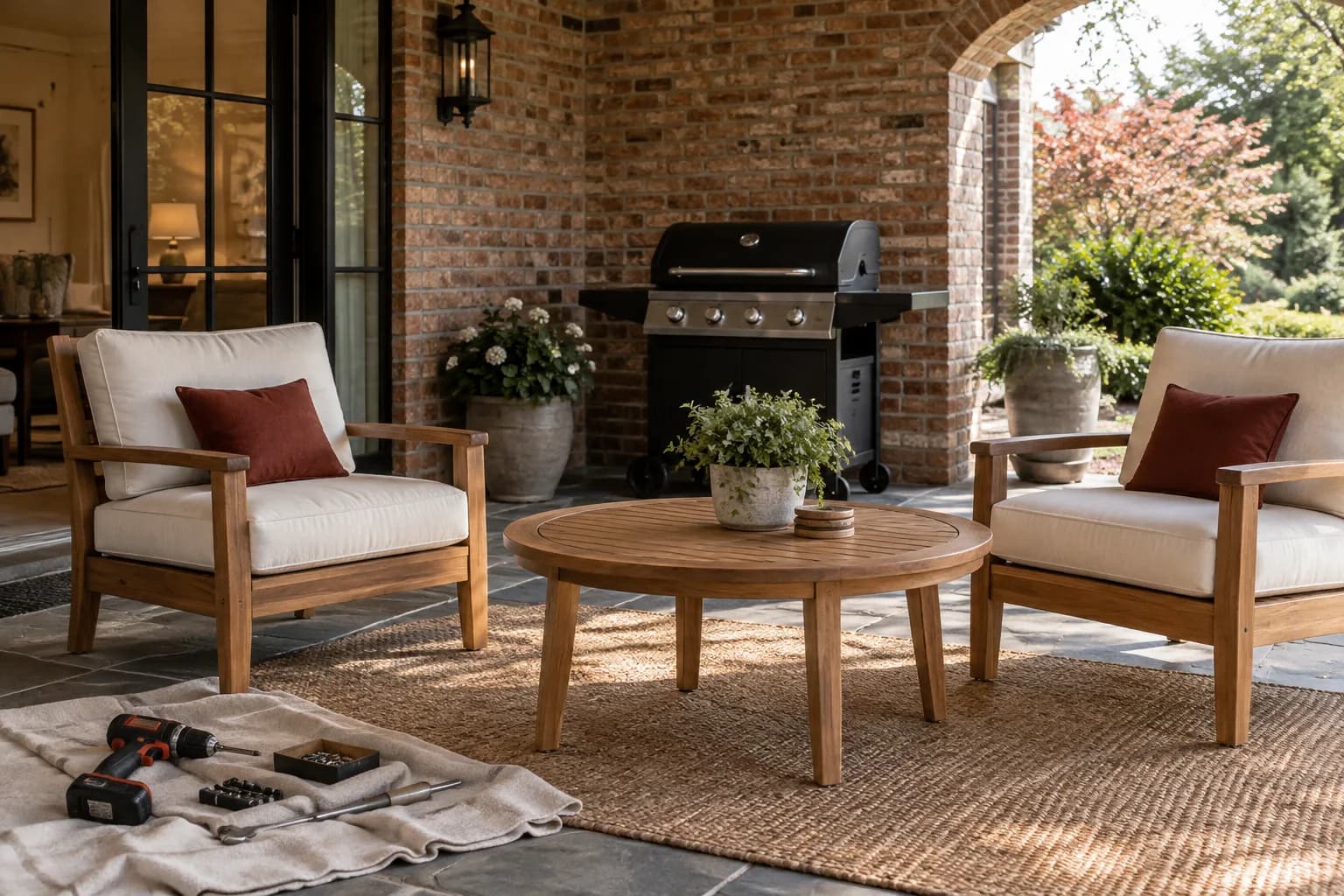
- For a gas grill, decide on final placement (well ventilated, away from anything that can burn, never indoors or in a garage, breezeway, carport, or porch) before assembly
- Inspect gas hoses and connections during assembly, and again each season
- Check cpsc.gov for recalls on your specific grill
Inspect outdoor pieces before assembly locks in a problem
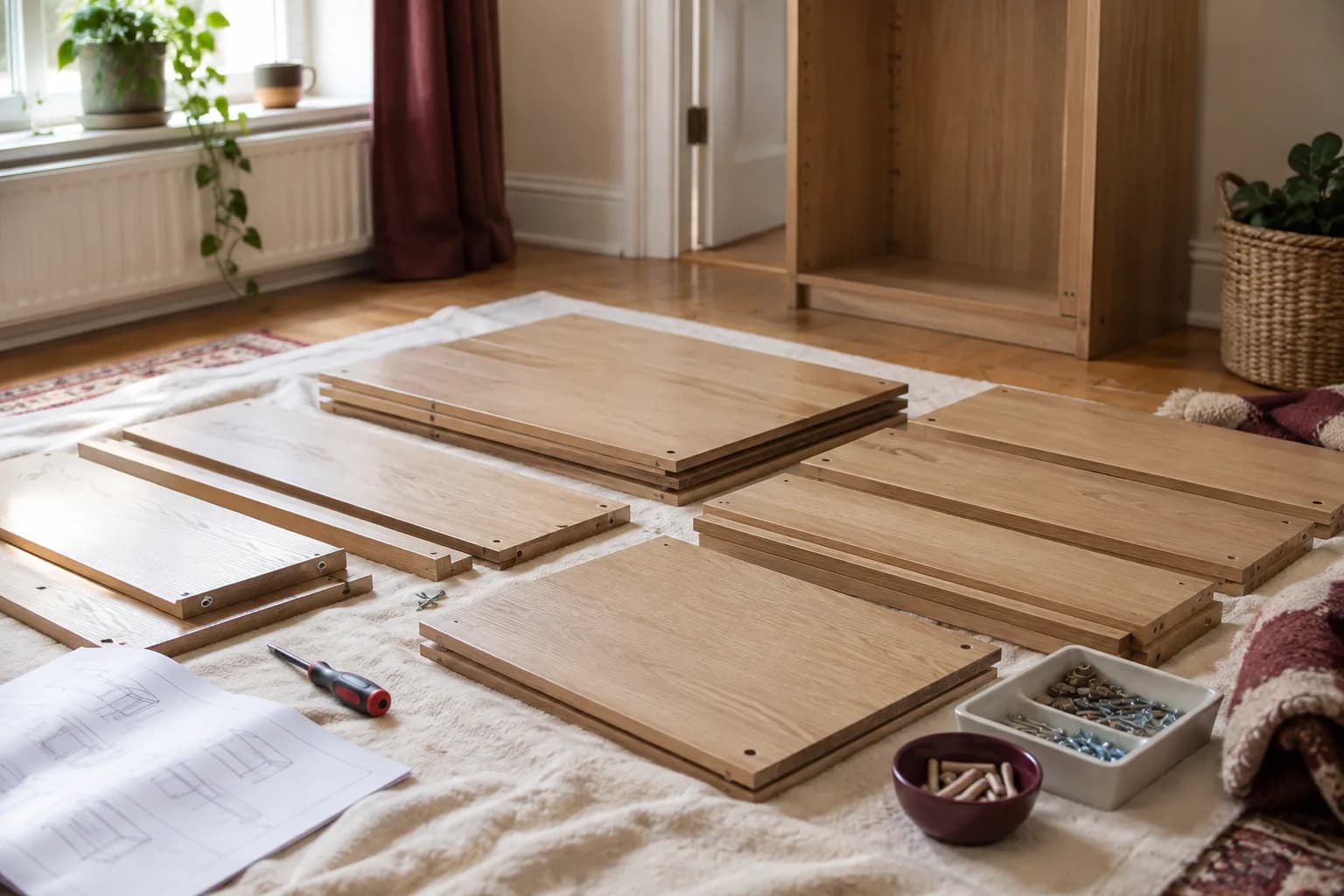
Open boxes in a clean, dry area and compare the contents with the parts list. Keep fasteners grouped by the manufacturer's labels. Several bolts can look alike while differing just enough in length to damage a panel or prevent a joint from seating. Photograph bent frames, cracked welds, missing finish, and damaged threads before trying to force parts together.
For a sectional, dry-position the separate modules where they will live before joining them. Check that the layout leaves room to walk around the table and open nearby doors. Confirm that feet rest securely on the patio surface. Outdoor paving can be uneven even when it looks flat; do not compensate by overtightening a frame until it twists.
If instructions call for loosely fitting all bolts before final tightening, preserve that sequence. It allows the parts to align naturally. Tightening the first joint fully can pull the remaining holes out of alignment and make a good product appear defective.
Treat the grill as equipment with its own commissioning steps
A cabinet, cart, or shelf can be mechanically assembled without proving that the cooking system is safe to operate. Keep those scopes separate. Fuel connections, conversions, damaged valves, and work on household gas piping belong with the manufacturer or an appropriately qualified specialist. Do not describe a completed cart assembly as a completed fuel-system inspection.
Read the exact model's placement and clearance instructions before choosing its permanent spot. A convenient location beside the kitchen door may not provide the clearance the maker requires. Also plan where the lid opens, where hot utensils can rest, and how people will pass without brushing the cooking area. A product photograph showing a grill close to a wall is not installation guidance.
Before first use, follow the manufacturer’s startup and safety checks. Keep the manual available, including the steps to take if the unit behaves abnormally. If a part arrives damaged, stop and resolve it through the supplier rather than treating the first cookout as a test of whether the damage matters.
Plan for the off-season while the furniture is new
Record the model and finish, keep spare assembly hardware, and identify which cushions or accessories need covered storage. Choose covers that fit the actual assembled shape and follow the maker's ventilation and care advice. A tightly wrapped wet cushion is not protected simply because it is under a cover.
At the next seasonal setup, inspect joints, feet, and exposed finish before regular use resumes. Clean according to the material's care instructions and replace missing caps or damaged fasteners with appropriate parts. A small record of the original hardware saves guesswork later, especially when a generic-looking bolt has a particular coating or length.
FAQ
Is pre-assembled outdoor furniture always better quality? Not necessarily — it saves you the assembly step, but the frame material, coating, and hardware quality matter more than whether it arrived built. Check those details regardless of which option you choose.
Do I need a professional to assemble a gas grill, or is it a DIY job? Many people assemble grills themselves successfully by following the manual closely, particularly the gas line and ignition steps. If you're not confident working with the fuel connections specifically, that's a reasonable part of the job to hand off.
Can outdoor furniture be moved indoors for winter instead of buying weather-resistant materials? Yes, and for cushions especially, indoor winter storage extends their life regardless of how weather-resistant they're rated. Whether a frame can stay out through winter depends on the material and the maker, so check the manufacturer's care instructions.
What's the biggest assembly mistake with sectional patio sets? A frequent one is getting the connector hardware between sections wrong — too loose and the set shifts and rattles, too tight and outdoor-rated plastic or composite parts can crack.
Get your patio and grill set up right
For outdoor furniture or a manufacturer's approved mechanical assembly scope, request an estimate with the exact model and instructions. Gas connections, fuel-system work, and conversions require an appropriate specialist and are not included in a Taskburgh assembly booking. See what else we cover on our furniture services page.