Quick answer
The sticker price on a piece of furniture is only part of what it costs you. The rest shows up later: the hour you spend fighting a stripped screw during assembly, the wobble that appears after a year, the drawer that stops closing square. When you compare furniture, compare the total cost — price plus the time and money you're likely to spend getting it together and keeping it together — not just the number on the tag.
Why the same-looking piece can cost so differently to own
Two dressers that look nearly identical in a listing photo can be built very differently underneath. The visible parts — finish, hardware, shape — are the easiest things to get right. The parts that decide how long a piece lasts are the ones you can't see in a photo:
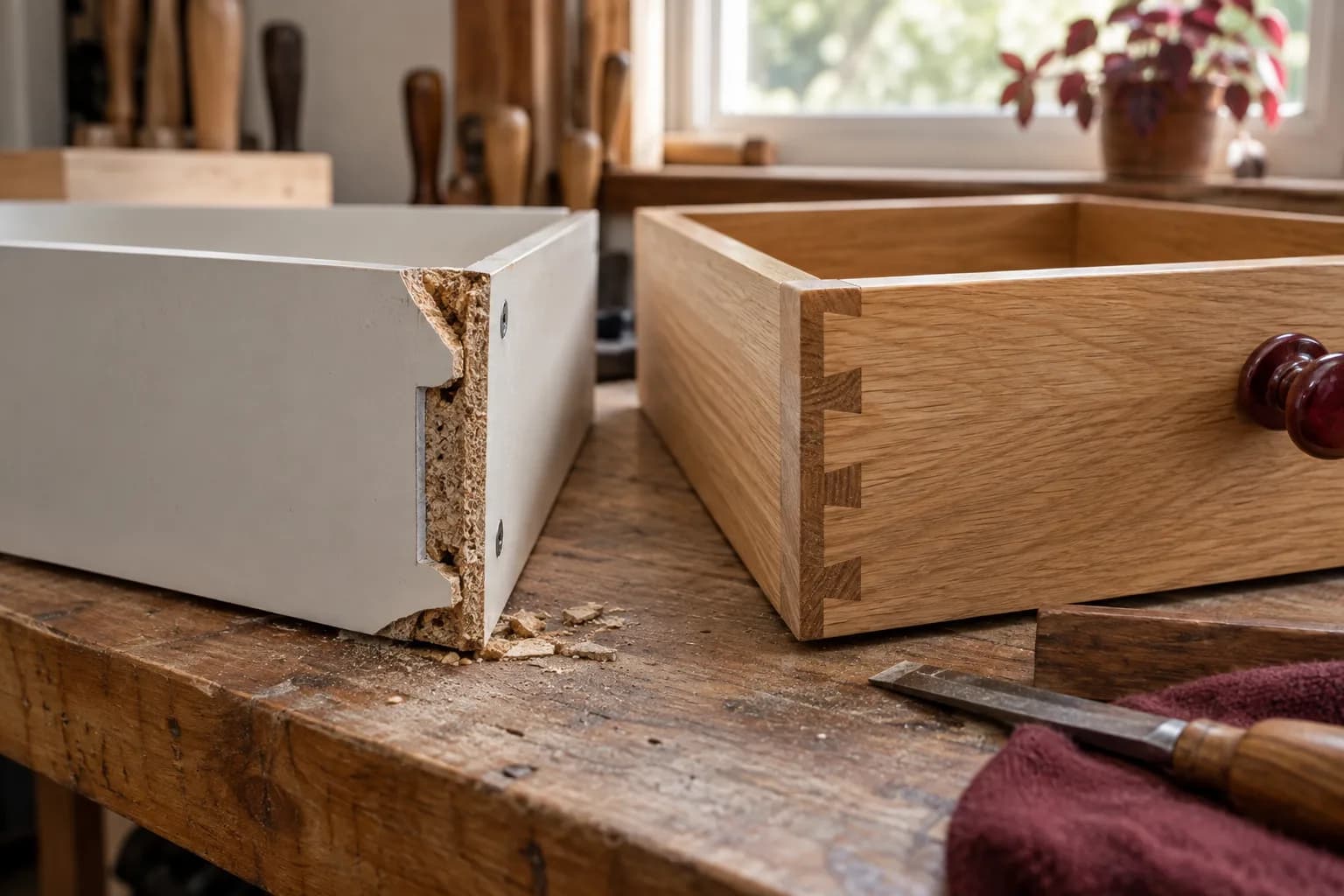
- What the panels are actually made of. "Wood furniture" can mean solid lumber, plywood, medium-density fiberboard (MDF), or particleboard, and those materials behave differently under load, moisture, and repeated assembly. The USDA Forest Products Laboratory's Wood Handbook describes particleboard as typically made in three layers, with fine particles on the faces and coarser material in the core, which gives a smooth surface for laminating, overlaying, painting, or veneering. It also notes that particleboard is "generally not as strong as fiberboard," and that it is the predominant material used in ready-to-assemble furniture. In other words, if you're buying flat-pack, you are very often buying particleboard with a decorative surface.
- How the joints are made. Screws driven straight into particleboard, cam locks with dowels, metal brackets, and traditional wood joinery all hold weight differently, and they tolerate being tightened, loosened, and moved differently.
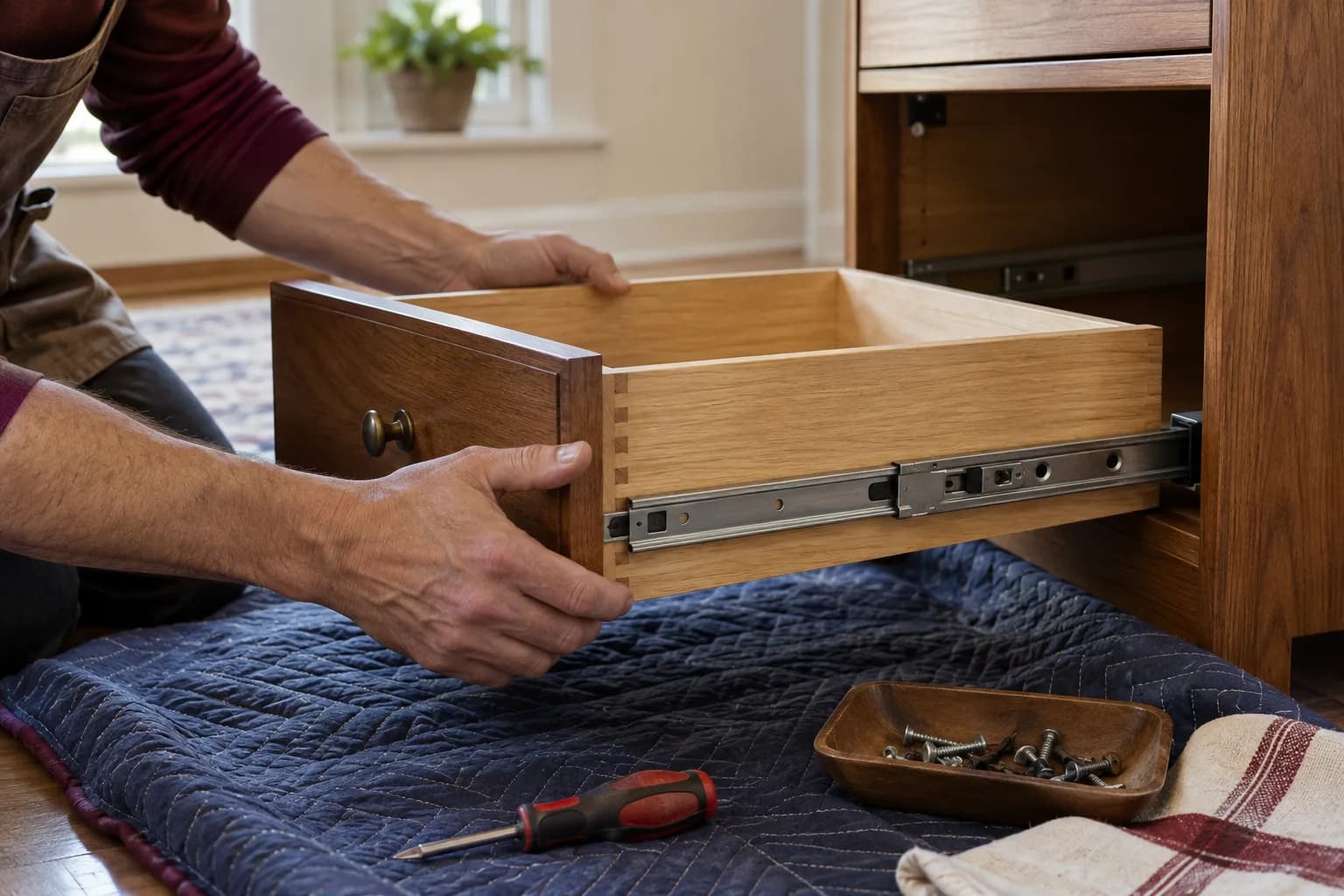
- What the hardware is built for. Drawer slides, hinges, and shelf supports are designed for a certain amount of weight and use. Lighter-duty hardware tends to show wear sooner when a piece gets heavy daily use.
None of this is obvious when you're comparing prices online. It becomes obvious after the piece has been in your home for a while — which is exactly when it's most inconvenient to deal with.
The three places the "cheap" cost shows up
1. Assembly time and frustration
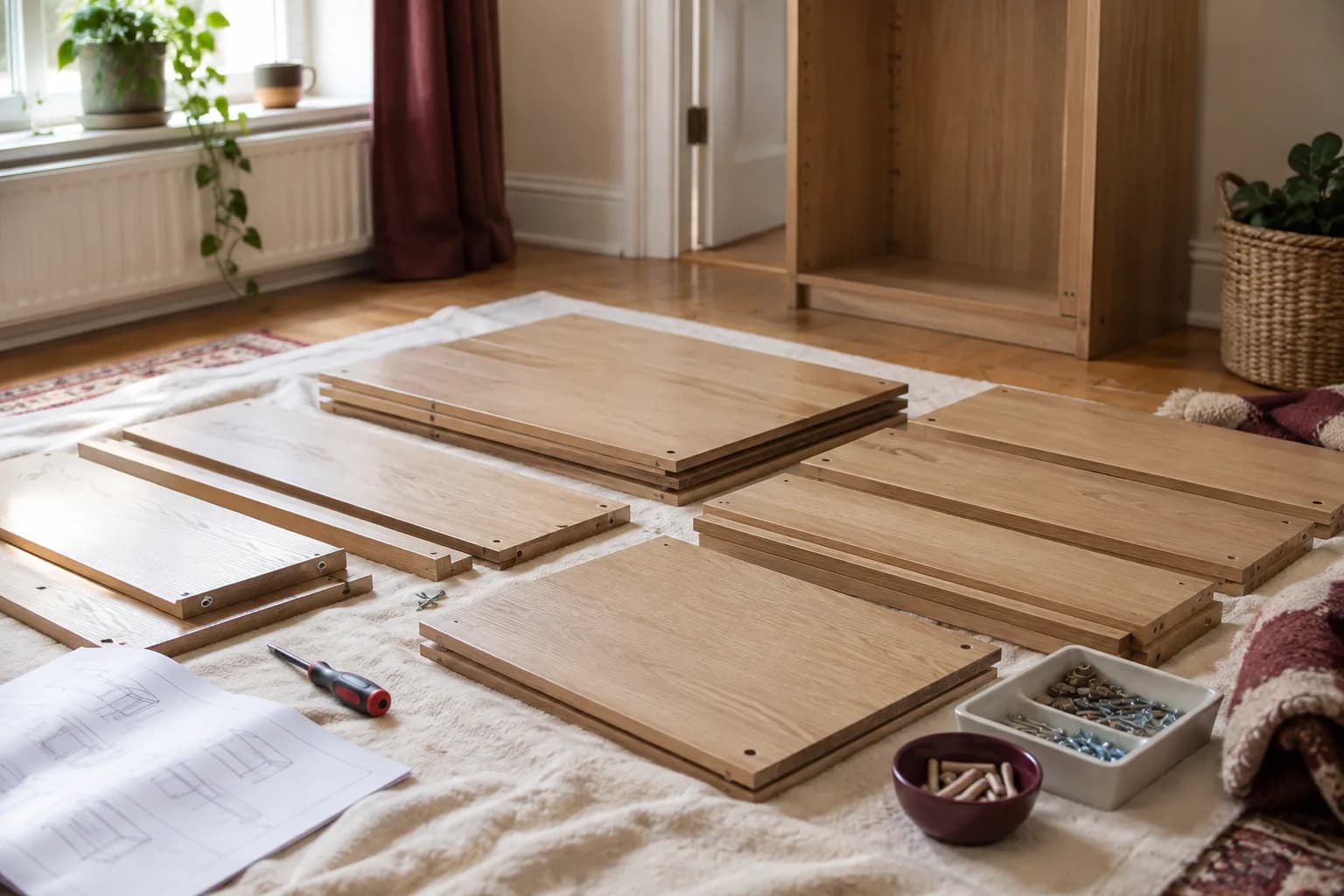
Budget furniture usually relies on pre-drilled holes in composite panels, and those holes have little tolerance for error. Drive a screw in at an angle, or overtighten it with a drill, and the hole can strip. Once that happens, the joint is weaker, and sometimes there isn't enough material left for the screw to bite into again. More parts, tight tolerances, and unforgiving materials mean assembly takes longer and is more likely to go wrong on a first attempt.
2. Everyday wear
A joint that was barely strong enough on day one doesn't get stronger with use. Every slammed drawer, bumped corner, or overloaded shelf puts a little more stress on thin panels and minimal hardware. That's why lower-cost case pieces often develop a wobble, a sagging shelf, or a drawer that won't close square sooner than a better-built piece used the same way.
3. Repair or replacement
Solid wood and plywood are generally easier to repair — a loose joint can often be reglued, and a worn screw hole can often be filled and redrilled. Particle-based panels are less forgiving. The Wood Handbook points out that plywood, unlike most panels made from particles, undergoes minimal irreversible thickness swelling if it gets wet. Put plainly: once particleboard has swollen from a spill or leak, or crumbled around a screw hole, it rarely goes back. At that point the realistic choice is often to replace the piece rather than fix it.
A simple way to compare before you buy
Before comparing two pieces on price alone, run through this list:
- What's the primary material — solid wood, plywood, MDF, or particleboard? Listings don't always say; ask if it isn't clear.
- How are the main joints made — screws into particleboard, cam locks and dowels, bolts into metal inserts, or wood joinery?
- What do the drawer slides look like — metal slides, or plastic runners and bare wood-on-wood?
- Is the back panel a real part of the structure, or a thin sheet tacked on?
- Where is the piece going? A kid's room or entryway sees heavy daily use; a guest room sees light use. Match the build quality to the job.
- Will you move it again soon? Composite furniture tends to handle being taken apart and reassembled poorly, so a move can shorten its life.
- How big is the price gap between the budget option and the sturdier one, compared with what it would cost you in time, repairs, or an early replacement? If the gap is small, quality usually wins on total cost.
When "cheap" is actually the right call
None of this means every purchase needs to be a premium one. A basic bookshelf for a rarely used guest room, a temporary piece while you settle into a new place, or furniture you already plan to replace in a year or two are all reasonable places to buy on price. Particleboard furniture can serve well when it stays dry, is assembled carefully, and isn't overloaded.
The point isn't to spend more everywhere. It's to spend deliberately, knowing which kind of purchase this is before you check out — and to put your money into the pieces that will carry weight, get used every day, or move with you.
A note for older Pittsburgh homes
Many older homes here have narrow, turning staircases and floors that are no longer perfectly level. Both matter for furniture. A piece that has to be carried up tight stairs in pieces, or that sits on an uneven floor, puts extra stress on its joints from the start. Sturdier construction and adjustable feet are worth more in those rooms than in a new build with wide halls and flat floors.
Compare two pieces against the same job
A fair comparison starts with intended use, not a price label. Write down what the piece needs to hold, how often it will move, how long you hope to keep it, and which parts get handled every day. A side table for a temporary guest room and a dresser opened every morning do not need the same construction priorities. Spending more is useful only when the extra money buys features relevant to that job.
For a hypothetical dresser comparison, inspect the drawers before concentrating on the finish. Can you identify the runner system and find adjustment instructions? Are replacement handles, runners, and fasteners available for the exact model? Is the drawer bottom supported in a way that suits the maker's stated use? Then consider the cabinet: does it have a clear assembly sequence, a complete back, and a documented anchoring method? A pretty exterior cannot answer those questions.
For a temporary side table, priorities might be simpler: correct dimensions, a stable assembled structure, a finish suited to ordinary use, and an uncomplicated return process. There may be little reason to pay for a heavy, difficult-to-move piece if you already know it will not fit your next room. The point is to choose deliberately rather than treating either low or high price as evidence of quality.
Look for repairability before something breaks
Search the manufacturer's support page for the assembly manual and spare-part process. A downloadable parts diagram lets you identify a missing connector; a generic customer-service address gives you less certainty. Ask whether replacement parts are sold individually and whether the model has a clear product number. Availability can change, so keep your purchase record even when support looks good today.
Pay attention to the parts that are most likely to be touched or adjusted: handles, hinges, runners, levelers, and connecting hardware. Accessible, identifiable components make ordinary maintenance easier. That does not mean every piece with replaceable hardware is a good buy, but it is a useful tie-breaker between otherwise similar options.
Also consider whether you are buying a piece meant to be disassembled. Do not assume that a flat-pack product tolerates repeated moves simply because it arrived in a box. Ask the manufacturer about reassembly and save the instructions. A design with damaged connector holes may no longer assemble securely even if its large panels still look presentable.
Inspect the delivery while you still have options
Before a long assembly session, check panel edges, major joints, drawer components, and the hardware inventory. Photograph damage beside the part label. Keep packaging until you know whether a replacement component or a return is needed, and avoid modifying a defective part to make it fit before speaking with the seller.
At the end of assembly, evaluate the functions you actually bought: doors meet cleanly, drawers travel as intended, the piece sits properly, and the specified anti-tip hardware can be installed. If those basics fail, another tightening session may not solve the underlying defect. A useful service assessment distinguishes an assembly adjustment from damaged materials or an unsuitable product, so you can decide whether repair or return is the better next step.
FAQ
Does "solid wood" always mean better quality? Not automatically. Solid wood is generally easier to repair and refinish than composite materials, but joinery, finish, and hardware still matter. A poorly joined solid-wood piece can still wobble, and a well-engineered plywood piece can outlast it.
Is MDF a bad furniture material? Not inherently. The Wood Handbook notes MDF is frequently used in place of solid wood, plywood, and particleboard in furniture. Its smooth, uniform surface also takes paint well. Problems usually come from thin panels, weak joints, or water exposure, not from the material alone.
Can a wobbly piece of furniture be fixed instead of replaced? Often, yes, if the material can still hold a fastener. Tightening or replacing loose hardware, adding corner braces, or regluing a joint can solve a lot of wobble. Once particleboard has stripped out or swollen, the options narrow quickly.
Is it worth paying for professional assembly on a budget piece? It can be, precisely because budget pieces leave little room for error. Careful, unhurried assembly lowers the odds of a stripped hole or a misaligned panel that shortens the piece's life.
Getting it put together well
Whatever you end up buying, how it's assembled affects how long it lasts. If you'd rather not risk a new piece on a first attempt with an unfamiliar bag of hardware, request an estimate and you'll see the full price up front, with no fees added after the job. You can also see everything we handle on our furniture services page.