Quick answer
Squeaks come from parts rubbing or shifting against each other, usually because a connection has loosened — often where the side rails meet the headboard and footboard. Sagging comes from a support system that isn't carrying the weight evenly: too few slats, slats too far apart, or a wide bed without solid center support. Before you buy, check the slats, the center support, and how the rails attach. After assembly, keep the hardware snug. That covers most of both problems.
Why bed frames squeak
A squeak is friction: two rigid parts moving against each other by a tiny amount every time weight shifts. Common sources:
- Rail-to-post connections. Many frames attach the side rails to the headboard and footboard with bolts or hook-and-slot brackets. Wood shrinks and swells a little as indoor humidity changes, and the everyday motion of getting in and out of bed slowly works hardware loose. A slightly loose bolt or bracket is one of the most common squeak sources.
- Slats rubbing on rails. Slats resting on a wood or metal ledge with nothing between them can creak as they shift under weight. A strip of felt, rubber, or fabric tape between slat and ledge prevents a lot of noise.
- Metal on metal. On metal frames, joints where two metal parts touch can squeak or tick as they flex. Check the original hardware and any manufacturer-specified pads or washers; do not add parts that change how the joint seats.
- A rocking center leg. If a center support leg doesn't reach the floor firmly or sits on an uneven spot, it can rock and knock under weight.
- The mattress or foundation, not the frame. Sometimes the noise comes from a box spring or the mattress itself. Lift the mattress off and press on the empty frame to check.
Why bed frames sag
Sagging is the support system bending downward under weight, usually in the middle of the bed. It comes from:
- Too few slats, or slats spaced too far apart. Wide gaps concentrate load on fewer slats and let a mattress dip between them. Thin or narrow slats bow more than sturdier ones.
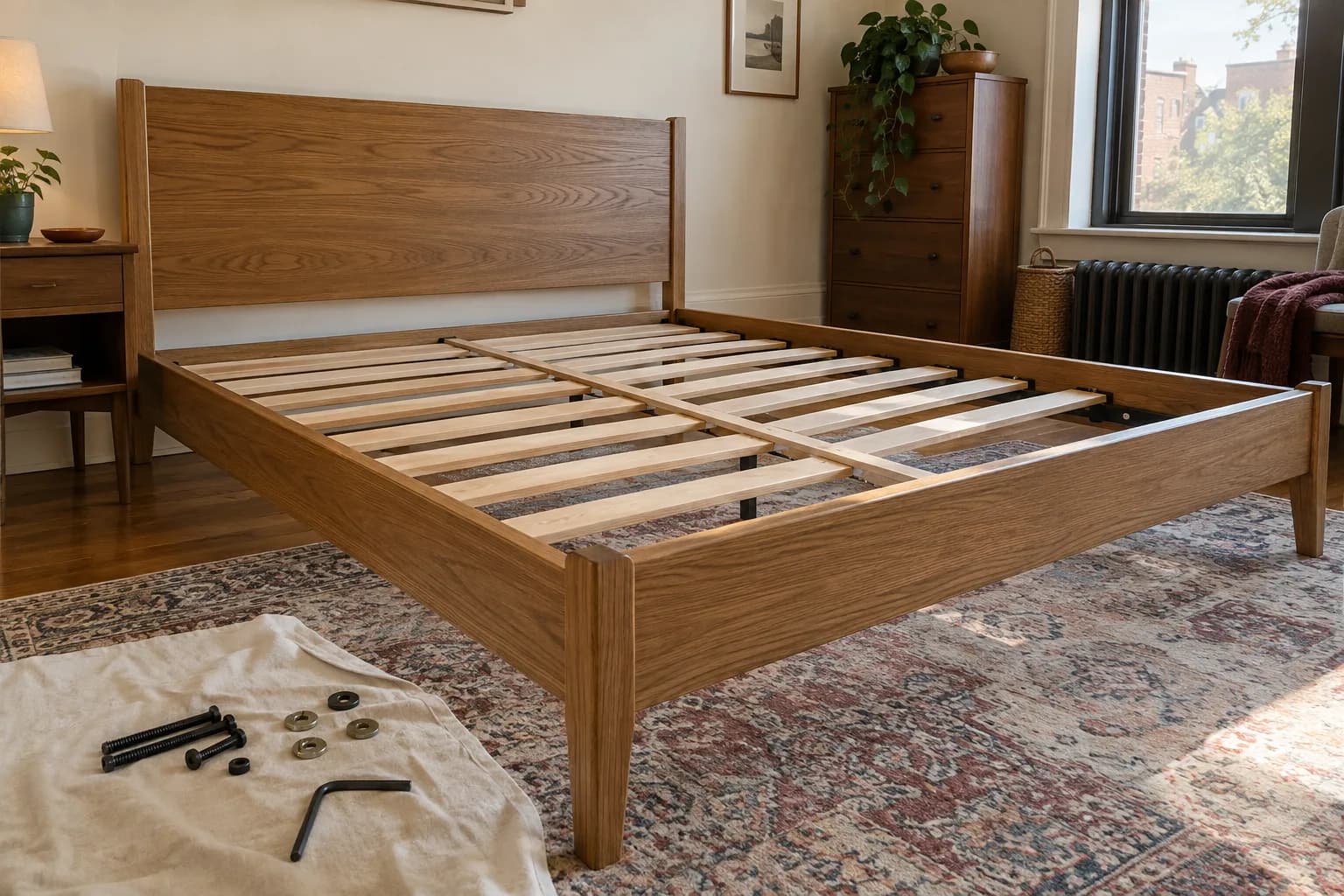
- Weak or missing center support on a wide bed. On a queen or king, the slats span a long distance from rail to rail. A center rail running from head to foot, with one or more legs to the floor, shortens that span. Without it, slats have to carry the whole width on their own.
- A foundation that doesn't match the mattress. Different mattresses call for different support. Mattress makers generally publish what kind of foundation or slat spacing their mattresses need, so check that before pairing a mattress with a frame.
What to check before you buy
- Slat count and spacing. Look for slats spaced closely and evenly. Compare the frame's stated spacing with your mattress maker's recommendation.
- Slats that stay put. Slats fixed in place, or linked by straps, don't wander apart and leave gaps the way loose slats can.
- Center support on queen and king frames. A center rail with legs to the floor is the feature most worth confirming for a wide bed. If a frame has no center support, look at how the manufacturer says the middle is supported.
- How the rails attach. Bolted connections into metal inserts can be retightened over and over. Hook-and-slot brackets are fast to assemble but worth checking periodically.
- Cushioning at contact points. Felt pads, rubber caps, or washers where slats and hardware meet the frame reduce squeaks over the years.
- Stated weight capacity. If the manufacturer lists one, make sure it fits how the bed will really be used — the intended occupants and mattress within the maker's stated use; do not treat a rating as permission to jump on the bed.
- Clearance and height. Check under-bed clearance if you need storage space, and make sure any center legs are adjustable to reach the floor.
A squeak and sag troubleshooting table
| What you notice | Likely cause | What to try |
|---|---|---|
| Squeak when you roll over | Loose rail bolts or brackets | Tighten all rail hardware evenly |
| Creak from underneath along the sides | Slats rubbing on the ledge | Add felt or fabric tape under slat ends |
| Knock or thump in the middle | Center leg not touching the floor firmly | Adjust the leg or add a floor protector pad to take up the gap |
| Ticking on a metal frame | Metal parts shifting at joints | Inspect and follow the specified hardware arrangement; replace missing parts correctly |
| Noise stops when the mattress is lifted off | Mattress or box spring | Check the mattress and foundation, not the frame |
| Dip in the middle of the bed | Slats too far apart or center support missing | Check the specified support system and obtain approved replacement or additional supports |
| Slats bowing visibly | Slats too thin for the load | Stop loading damaged supports and identify a manufacturer-approved repair |
Keeping a good frame quiet and level
- Retighten hardware a few weeks after assembly, then check it periodically. Wood settles around fasteners, especially early on.
- Tighten evenly. Snug each bolt a little at a time, alternating sides, so the frame pulls together square.
- Don't overtighten screws or bolts into wood. Too much force can strip the hole, and a stripped hole loosens faster than before.
- Use pads only where appropriate to the design and consistent with the manufacturer's guidance; do not change structural joints to silence them.
- Recheck the center legs after moving the bed. Floors in older homes — including many Pittsburgh houses with original hardwood — are often not level, so a leg that touched the floor in one spot may float in another.
- Mind the seasons. Humid summers and dry, heated winters mean wood moves through the year, so a frame that was silent in August may creak in January. A quick hardware check when the heat comes on is a good habit.
Diagnose the location before ordering replacement parts
A useful inspection separates the bed into three systems: the floor and feet, the frame and its connections, and the mattress or foundation. Start by describing when the sound happens. Does it occur when someone gets in, when the mattress shifts, or when you push the headboard? Does the bed visibly rock? Record a short video of the symptom rather than repeatedly stressing a joint to make the noise louder.
With the bed unloaded and accessible, look for a foot that is not touching the floor, a rail that has pulled away from a post, or a slat that has left its intended support. Do not crawl under an unstable frame or ask someone to sit on it during an underneath inspection. A crack, bent connector, missing support, or loose metal insert changes the question from quieting the bed to making it safe to use. Stop using a visibly compromised frame until the appropriate repair is identified.
As a hypothetical example, a bed may seem quiet after tightening the headboard but still rock because one center foot is suspended above an uneven floor. Conversely, the frame may stand firmly while the foundation makes the noise. Those are different repairs. Adding cushions everywhere can hide a symptom without fixing the loose connection that caused it.
Match the repair to the original support system
Before buying generic slats or a replacement center beam, find the model label and assembly manual. Photograph the whole frame, the underside layout, and the damaged part. A manufacturer may offer the correct replacement connector or specify a support kit; that is more useful than guessing from the bed's advertised size. Beds with storage drawers, lift mechanisms, adjustable bases, or upholstered rails may have parts that are not interchangeable with an ordinary platform frame.
Ask whether a proposed change affects mattress support requirements or the frame warranty. A stronger-looking piece of lumber is not automatically an approved replacement, and adding washers can change how a connector seats. Follow the original hardware arrangement unless the manufacturer or a qualified repair assessment supports a change. The same caution applies to lubricants around upholstery and finished wood: check compatibility before applying anything.
For a new delivery, inspect before assembly makes a return difficult. Count the center feet, identify the rail connectors, compare slat dimensions with the parts diagram, and look for split ends or damaged inserts. Keep the product label and hardware bags until the frame is assembled and checked. If a load-bearing part is missing, pause rather than completing the bed without it.
The final check should answer ordinary-use questions: does the frame sit without rocking, are the specified supports installed, do drawers clear the floor, and can the mattress sit as designed? Keep the manual with a photo of the completed support layout. That record makes a later move or squeak investigation much less speculative.
FAQ
Does a box spring replace the need for center support? Not necessarily. It depends on the frame and the mattress. Check the frame's instructions and the mattress maker's foundation guidance before leaving out a center support on a wide bed.
Is a squeaky bed frame about to fail? Usually not. A squeak is typically a loose fastener or an unpadded contact point. A visible sag, a cracked slat, or a joint that moves when you push on it is the more serious sign to deal with.
Are platform beds less prone to sagging? They can be, when the slats are sturdy and closely spaced and larger sizes have center support. The same checks apply to any frame.
How often should I check the hardware? A few weeks after assembly, then whenever you hear a new noise or move the bed. A quick check with the seasons is plenty for most frames.
Get help with assembly or a fix
A squeaky or sagging bed is often a small fix rather than a replacement — tightened hardware, a few pads, added slats, or a center support. Request an estimate and we'll give you the full price before we start. See more on our furniture services page.