Quick answer
Before you order a sofa, dresser, or dining table for a new place, measure the entire path it has to travel — not just the room you're putting it in. That means doorways, hallways, stairwell turns, and the elevator if there is one. The trouble spot often isn't the front door at all — it's a narrow hallway turn or a low ceiling over a stairwell landing that nobody thought to check.
Key takeaways
- Measure the whole path, not just the destination room
- For sofas and other deep pieces, the "diagonal depth" often decides whether it can tilt through a door
- Stair landings can make or break a turn, even on a technically "wide enough" staircase
- Elevator cab size and door opening matter as much as the weight limit
- When in doubt, measure twice and check the manufacturer's exact dimensions before buying
The diagonal rule: why doorway width alone isn't enough
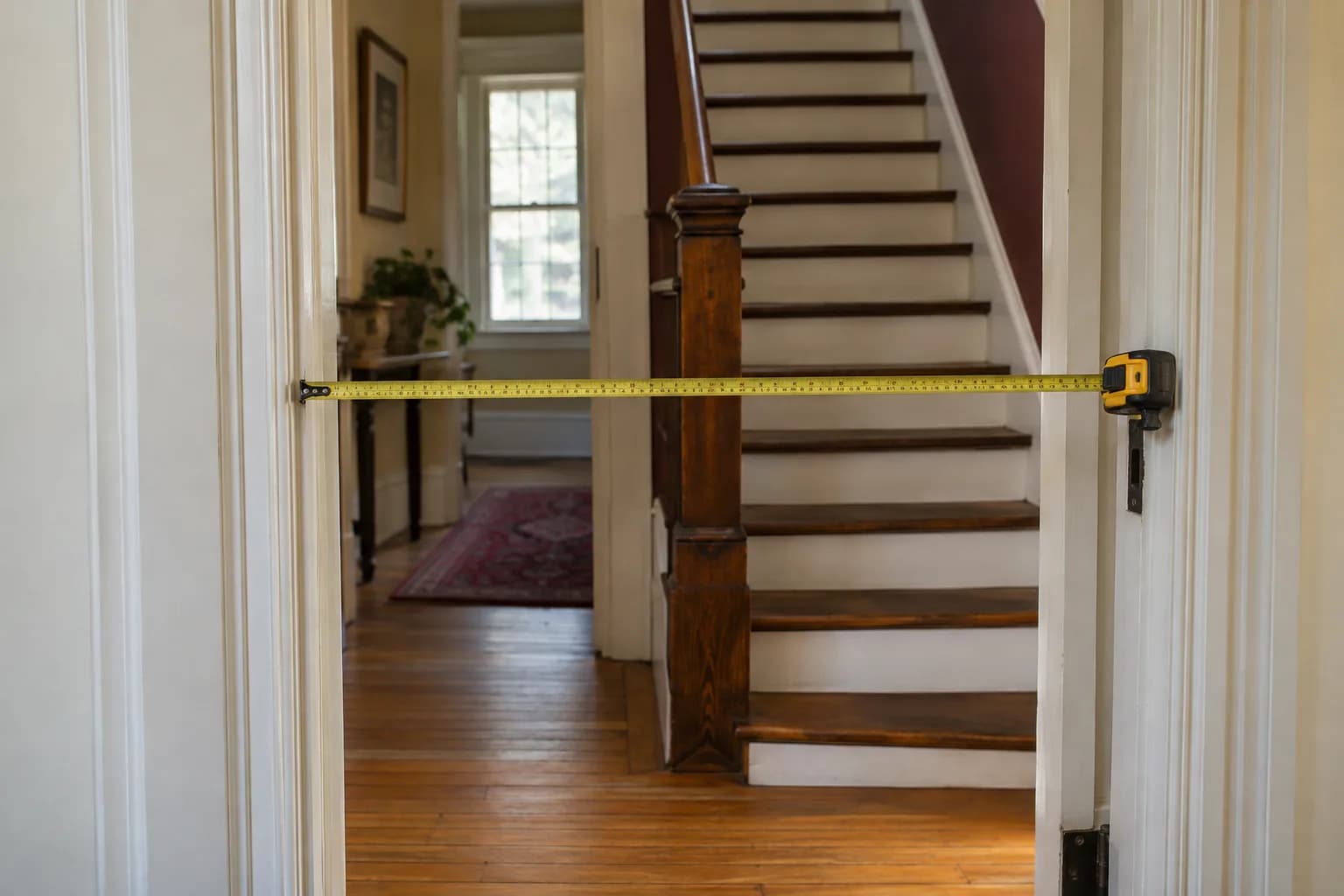
Two things trip people up at doorways. First, the usable opening is smaller than the door itself: with the door swung fully open, the door's own thickness and the stop molding eat into the space. Measure the clear opening — from the face of the open door to the doorstop on the opposite side of the frame — not the door slab.
Second, large pieces are rarely carried through flat. A sofa is usually stood on end or tipped back and angled through, so its full width (end to end) often isn't the number that matters at the door. For pieces with a sloped or stepped profile, like most sofas and armchairs, the useful number is the diagonal depth. Use the manufacturer's measurement diagram for the exact model rather than applying a generic diagonal measurement to every shape. Ask the retailer to confirm the relevant clearance and orientation. A diagonal dimension is one input to a delivery assessment, not a guarantee that the piece can turn through the complete route.
If the clear opening is wider than the diagonal depth, the piece can often be tipped back and angled through — as long as its length can also clear the door height, and there's room on both sides of the door to pivot it. A boxy piece like a dresser or wardrobe has no sloped profile to help, so check that two of its three dimensions fit inside the opening — usually its depth through the door's width, and its height or width through the door's height.
Before you buy, check the manufacturer's listed width, depth, and height (some listings include diagonal depth too), and ask whether legs, feet, or doors can be removed for delivery.
Doors and doorways: what to measure
- Clear opening width of every doorway on the path (front door, vestibule, interior doors along the route)
- Height of each doorway — don't assume they're all the same, especially in older homes
- Whether the door swings out of the way completely or has to stay partially closed (hinges, adjacent walls, thresholds)
- Any storm doors or screen doors that add an extra pinch point at the entrance
Hallways and turns: the real bottleneck
A hallway wide enough to walk through comfortably can still be too tight to turn a large piece of furniture through a 90-degree corner. Measure:
- Hallway width at its narrowest point (radiators, handrails, and deep trim can jut out)
- The width of any turn or corner the furniture has to navigate, not just the straight sections
- Ceiling height in the hallway if you're moving anything tall (bookshelves, armoires)
Stairs: width, ceiling clearance, and landings
Stairs combine three separate constraints, and it's easy to check only one:
- Narrowest width of the staircase itself
- Overhead clearance, especially where a stairwell has a sloped ceiling or a low beam
- Landing size at any turn — a deep landing can make an otherwise tight turn possible, while a shallow one can stop a piece that would fit on a straight run
In older Pittsburgh rowhouses and hillside homes, the stairs can be the real limit: a narrow interior staircase with a tight turn, or a run of exterior steps up to the front door where there's little room to set a heavy piece down and adjust your grip.
Elevators: cab size and door width, not just weight limit
For condo, apartment, or high-rise moves, the elevator introduces its own set of numbers:
- Interior cab dimensions (width, depth, and height) — ask building management or measure the cab yourself
- Elevator door opening width and height, which can be smaller than the cab itself
- Weight limit, if you're moving something genuinely heavy (a large wardrobe, a piano)
- Whether the building has a freight or service elevator, its dimensions, and whether it has to be reserved for moves or deliveries
Don't forget the room itself
Once a piece clears the path, it still has to work in the room:
- Room dimensions and the swing radius of any doors inside the room
- Space needed for drawers, doors, or recliner mechanisms to fully open
- Clearance around the piece for walking paths, other furniture, and vents or outlets
A pre-purchase measuring checklist
- Measure every doorway, hallway, and turn from the building entrance to the final room
- Note ceiling heights anywhere the path is unusually low
- Check stairwell landings, not just the stair width
- Get elevator interior and door dimensions if applicable
- Compare against the manufacturer's exact width, depth, height, and diagonal depth (if listed)
- Use painter's tape on the floor to mock up large pieces before buying
- When a fit looks tight, ask the retailer or delivery service if they've had trouble with that specific model in similar buildings
Measure the delivery package and the finished furniture separately
The dimensions on a product page may describe the assembled item, the shipping carton, or both. Record which measurement you are using. A large flat-pack desk might arrive in a long, relatively thin carton that fits a hallway easily, while the completed desk cannot make the same turn. An upholstered sofa may arrive with removable feet, but that does not mean the arms, back, or internal frame can be removed.
Ask the retailer for the packed dimensions and any manufacturer-approved disassembly instructions before purchasing. Treat a removable part as removable only when the maker says it is. Cutting upholstery, bending a frame, or dismantling glued joints is not a normal delivery adjustment. Also check the return terms before opening packaging; a “we will make it fit” assumption can become an expensive commitment.
Build a route sheet instead of collecting disconnected numbers
Sketch the route from the delivery entrance to the final room. Give each bottleneck a letter: entrance A, hallway turn B, stair landing C, bedroom door D. Write measurements next to each letter and take a photo facing each turn. Include the handrail, ceiling slope, door closer, light fitting, and any radiator that reduces the useful space. The narrowest clear passage matters more than the nominal door size.
Imagine a bookcase that fits through both doors but must rotate between them in a short hall. Measuring only the door openings misses the problem. A cardboard floor template can help you understand the footprint and turning room, but it cannot prove that a rigid three-dimensional object will clear a low ceiling. Ask the delivery company to evaluate complicated routes rather than treating a diagonal calculation as a guarantee.
Keep the destination in the same plan. There must be room to lay panels down, assemble the item in the required sequence, and stand it upright without hitting the ceiling. A tall wardrobe that fits when upright may require more clearance while being raised. Follow the manufacturer's assembly-space instructions or choose a design intended to assemble upright.
Separate delivery, assembly, and installation
These are different jobs with different equipment and responsibilities. Confirm that the retailer or a suitable moving company will place the boxes in the room where assembly will happen. Ask who removes packaging, whether anchoring is included, and whether the wall is suitable for the supplied anti-tip system. Taskburgh can discuss furniture assembly and appropriate mounting, but moving and heavy lifting are not part of our service offering.
Save the route sheet with the order confirmation. It is useful for the retailer before delivery and for the assembly team afterward; it also lets you compare an alternative item without measuring the entire home again.
FAQ
What if a piece is listed as "flat-pack" or ships disassembled — do I still need to measure the whole path? You need less clearance for the boxed components, but you'll still need enough room in the destination area to assemble it, and the individual boxes still have to travel through the same doors and hallways. Check the largest single box dimension, not just the assembled size.
How much extra clearance should I leave beyond the exact measurements? There's no universal number — it depends on how much the piece can tilt or angle through the tightest point. When a fit looks close, a physical mock-up (painter's tape or a cardboard cutout) is more reliable than adding an arbitrary buffer.
Do delivery companies check these measurements for me? Don't count on it. Some retailers ask basic questions, but confirming the fit is generally left to you, so read the return and delivery policy before ordering — returning a large piece that didn't fit can be a hassle and may come with fees. Doing the measuring yourself before you order is the safer route.
What's the most commonly overlooked measurement? Stairwell landings and hallway turns. People tend to measure the doorway and the room itself, but forget that a piece has to physically pivot somewhere along the path — and that's a common place for a move to get stuck.
Plan delivery and assembly before ordering
Ask the retailer or an appropriate delivery provider to confirm the access route. Taskburgh does not offer moving or heavy lifting. Once boxes are in the assembly room, we can discuss furniture assembly; request an estimate with the model, instructions, and room photographs.